The Only Family Puppy Training Plan That Actually Works (No More Mixed Signals!)
Bringing a new puppy into your home is one of the most exciting experiences a family can share. There is nothing quite like the joy of a fluffy, clumsy little pup running around the living room, bringing everyone together. But let us be completely honest with each other for a second: fast forward two weeks, and that initial bliss often turns into a chaotic mess of chewed-up sneakers, indoor puddles, and a lot of frustrated yelling. Why? Because while your puppy is eager to learn, they are getting completely different instructions from every single person in the house.
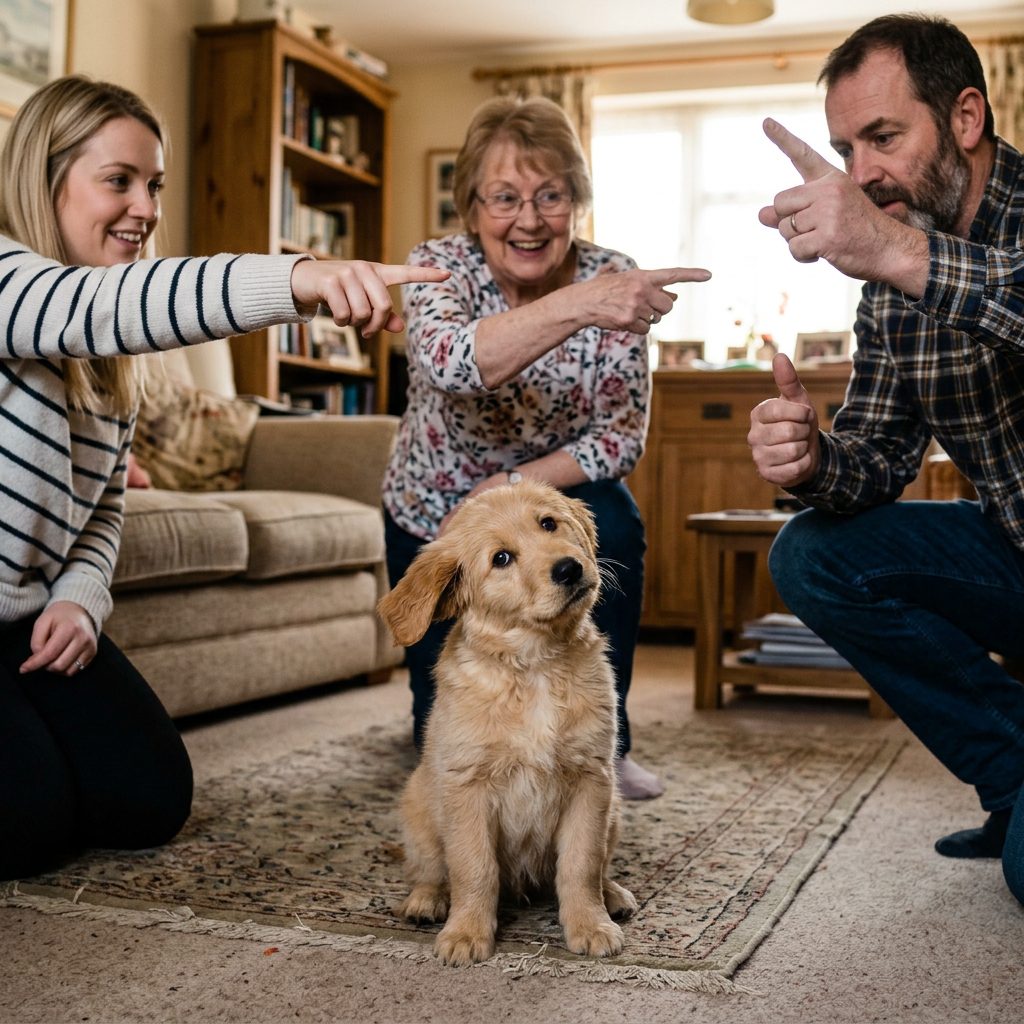
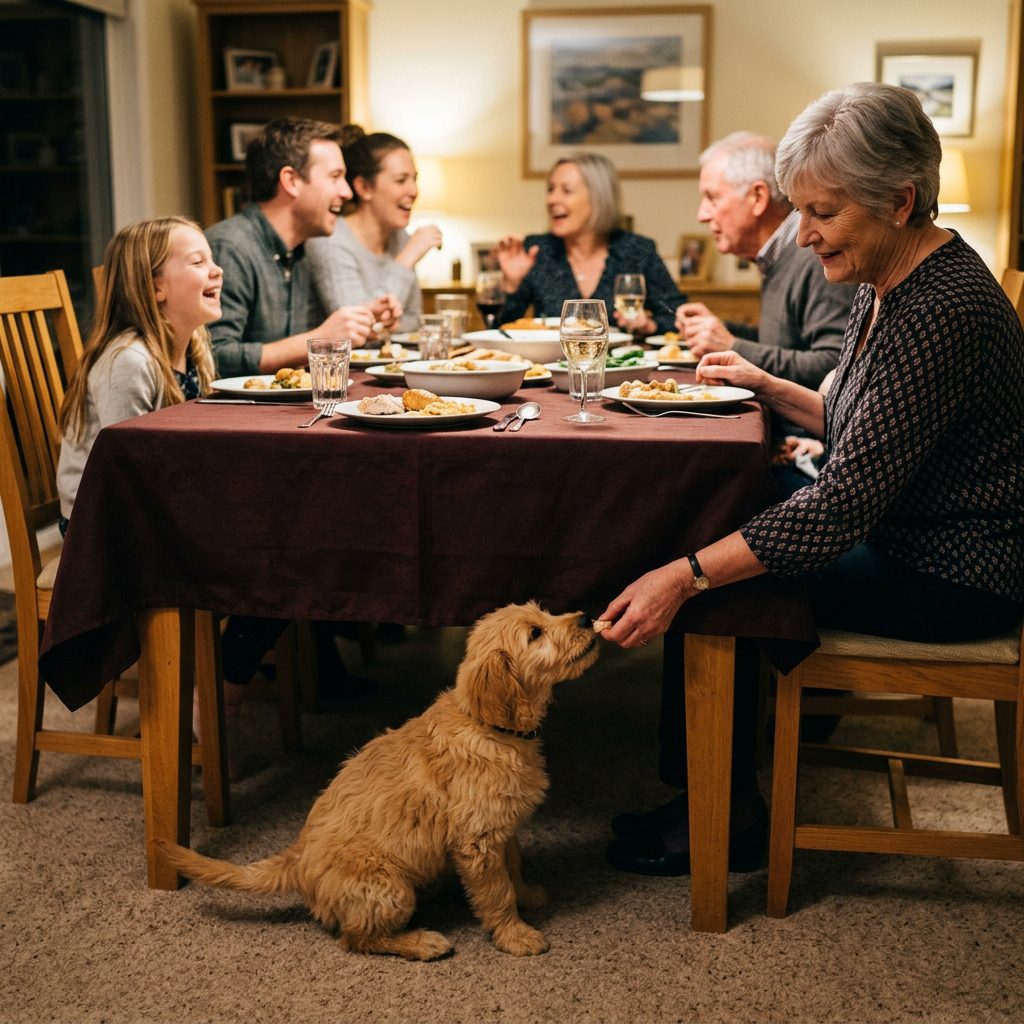
Think about it from your puppy’s perspective. Dad says Down when the puppy jumps on the couch. Mom says Off for the exact same behavior. The kids just squeal and push the puppy away, which the puppy interprets as a super fun wrestling match. Meanwhile, Grandma is sneaking pieces of turkey under the dinner table. It is no wonder your smart little dog is acting out—they are receiving a barrage of mixed signals! As savvy dog owners, you know that dogs thrive on clear communication and predictable routines. When the rules change depending on who is in the room, your puppy cannot succeed.
That is exactly why we have put together The Only Family Puppy Training Plan That Actually Works. This is not just another list of commands; it is a comprehensive, step-by-step blueprint designed to get your entire household on the exact same page. We are going to treat your family like a unified training team. By eliminating the mixed signals, you will drastically cut down on training time, reduce your pup’s anxiety, and build a beautiful, lifelong bond between your dog and every member of your family. Let us dive into the ultimate strategy for raising a well-adjusted, brilliantly behaved family dog.
The Golden Rule: Why Consistency is Everything (and How Families Mess It Up)
Understanding the Canine Mind
Before we can fix the behavior, we have to understand how our puppies learn. Dogs learn through association and repetition. They do not speak English, Spanish, or any other human language; they learn to associate a specific sound (a command) or a specific hand signal with an action, and subsequently, a consequence (a reward or lack thereof). When that association is clear and consistent, learning happens rapidly. When the association is muddy, learning stalls, and frustration sets in for both you and your dog.
In a family setting, inconsistency is the number one enemy of dog training. If a puppy is allowed to jump on the kids because the kids think it is cute, but gets scolded by the parents for jumping on guests, the puppy does not understand the nuance. To the puppy, jumping is either a rewarding behavior or it is not.
Consistency is not just about using the same words; it is about enforcing the same boundaries, offering the same rewards, and reacting the same way to unwanted behaviors, no matter who is in the room.
The Mixed Signals Disaster
Let us look at a practical example of how families unintentionally sabotage their own puppy training efforts. Below is a breakdown of a very common household scenario that illustrates exactly why your puppy might be ignoring you.
| Family Member | Command Used for Jumping | Action Taken | What the Puppy Learns |
|---|---|---|---|
| Dad | “Down!” | Pushes puppy away firmly | “Down” means a physical wrestling game is starting. |
| Mom | “Off!” | Turns back and ignores | “Off” means the human is boring, I should try harder to get attention. |
| Teenager | “Stop it!” | Pets the puppy while saying it | “Stop it” means I get affection for jumping! |
| Youngest Child | Squeals and runs | Runs away laughing | Jumping triggers a high-speed chase game (the best reward ever!). |
As you can see, the poor puppy is getting four completely different reactions to the exact same behavior. To fix this, your family must become a united front. The rules must be black and white, with absolutely no gray areas during the crucial first few months of training.
The Family Meeting: Setting Your Puppy’s Blueprint
Getting Everyone on the Same Page
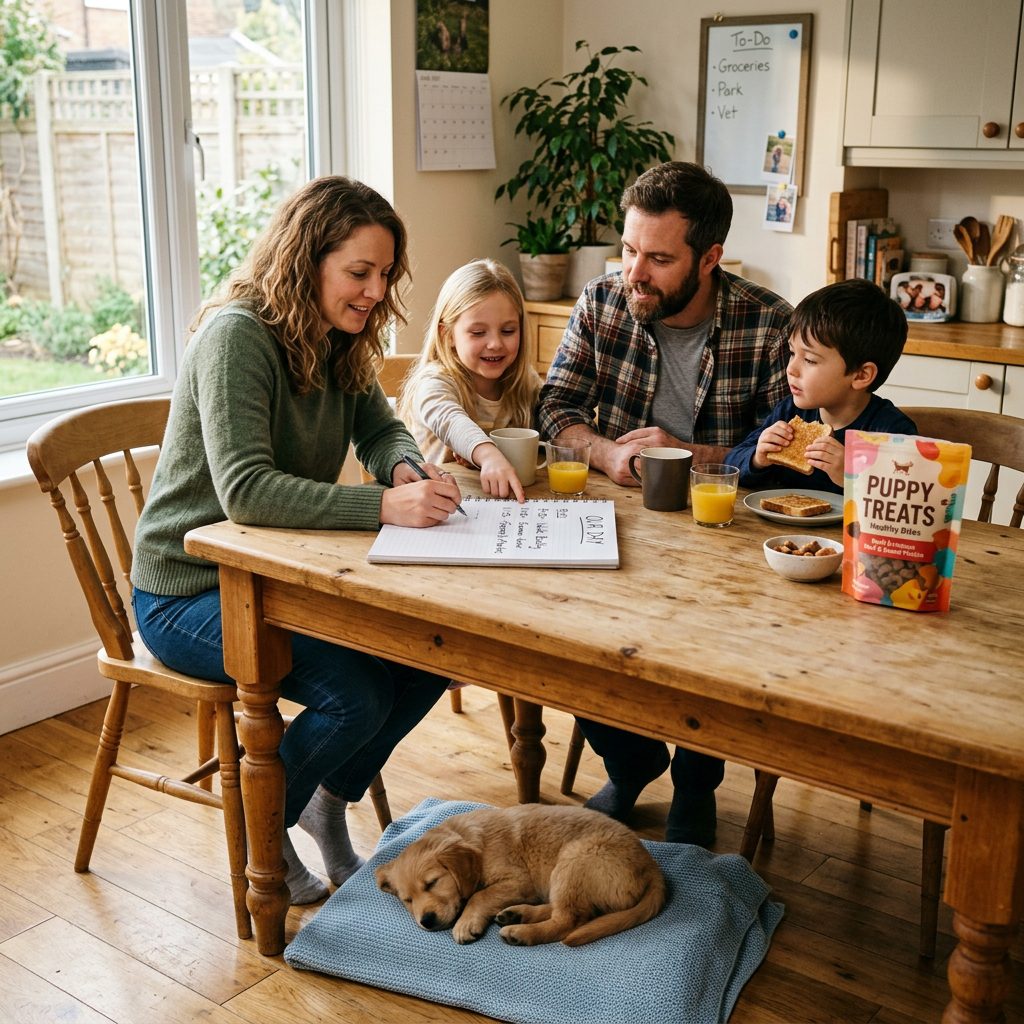
You cannot successfully raise a family dog without a family meeting. Before you even begin formal training sessions, you need to sit down with everyone in the household—yes, even the kids—and draft your Puppy Training Blueprint. This meeting is where you will decide on your vocabulary, establish the house rules, and assign responsibilities so that the burden does not fall solely on one person.
Step 1: The Unified Vocabulary List
First, you must agree on the exact words you will use for commands. Write these down and stick them on the refrigerator so nobody forgets. Here is a standard starter list you can adopt:
- Sit: Put your bottom on the floor.
- Down: Lie down with your belly on the floor (Do NOT use this for jumping).
- Off: Get all four paws on the floor (Use this when the dog jumps on people or furniture).
- Come: Stop what you are doing and run to me immediately.
- Leave It: Ignore that item on the ground or walk away from it.
- Drop It: Let go of whatever is currently in your mouth.
- Place: Go to your bed or mat and stay there until released.
Step 2: Establishing House Rules
Next, determine the boundaries. Will the puppy be allowed on the furniture? Are they allowed in the kitchen while you are cooking? Where will they sleep? If Mom says the dog is allowed on the bed but Dad says absolutely not, you have a major problem. Decide together and commit to enforcing these rules 100% of the time.
Step 3: Creating a Predictable Schedule
Puppies thrive on routine. A predictable schedule helps with potty training, reduces anxiety, and ensures your puppy gets the right balance of physical exercise, mental stimulation, and sleep (puppies need 18-20 hours of sleep a day!). Here is an example of a balanced family schedule that shares the load:
| Time of Day | Activity | Family Member Responsible |
|---|---|---|
| 7:00 AM | Morning potty break, breakfast, and 10-minute training session | Parent 1 |
| 8:00 AM – 12:00 PM | Crate time / Nap time | N/A (Puppy rests) |
| 12:00 PM | Midday potty break and short walk or play session | Parent 2 or Dog Walker |
| 1:00 PM – 4:00 PM | Crate time / Nap time | N/A (Puppy rests) |
| 4:00 PM | Afternoon potty break, play, and socialization | Older Children / Teenagers |
| 6:00 PM | Dinner time for puppy, followed by immediate potty break | Parent 1 |
| 7:00 PM | Family relaxation (supervised tethering or playpen time) | Whole Family |
| 9:30 PM | Final potty break before bed | Parent 2 |
Step-by-Step: Executing the Unified Training Plan
Putting the Plan into Action
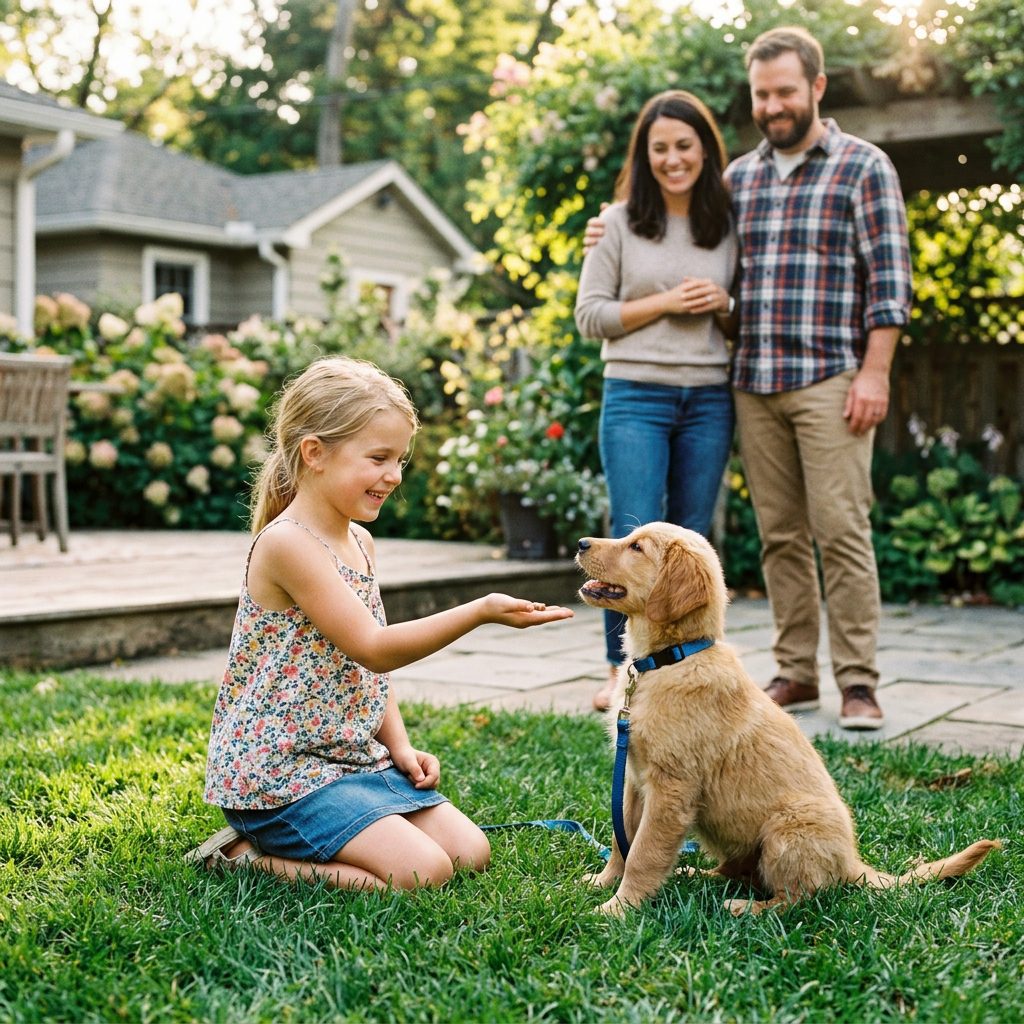
Now that your family has agreed on the vocabulary, rules, and schedule, it is time to actually train the puppy. Executing the plan requires patience, positive reinforcement, and a few essential tools. Make sure you have a treat pouch stocked with high-value rewards (like small pieces of boiled chicken or soft training treats), a clicker (if you choose to use clicker training), and a lightweight house line (a short leash the puppy wears indoors to help you manage their movements safely).
Phase 1: The One-Command Rule
One of the most common mistakes families make is repeating commands like a broken record. Sit. Sit. Sit down. Buddy, sit! When you do this, you are teaching the puppy that the command is actually a whole sentence, or that they do not have to listen the first time. The rule for the whole family must be: Say the command only once. If the puppy does not comply, it means they either do not understand what you are asking, or they are too distracted. Instead of repeating the word, use a high-value treat to lure them into the position, and reward them immediately when they succeed.
Phase 2: The Reward System
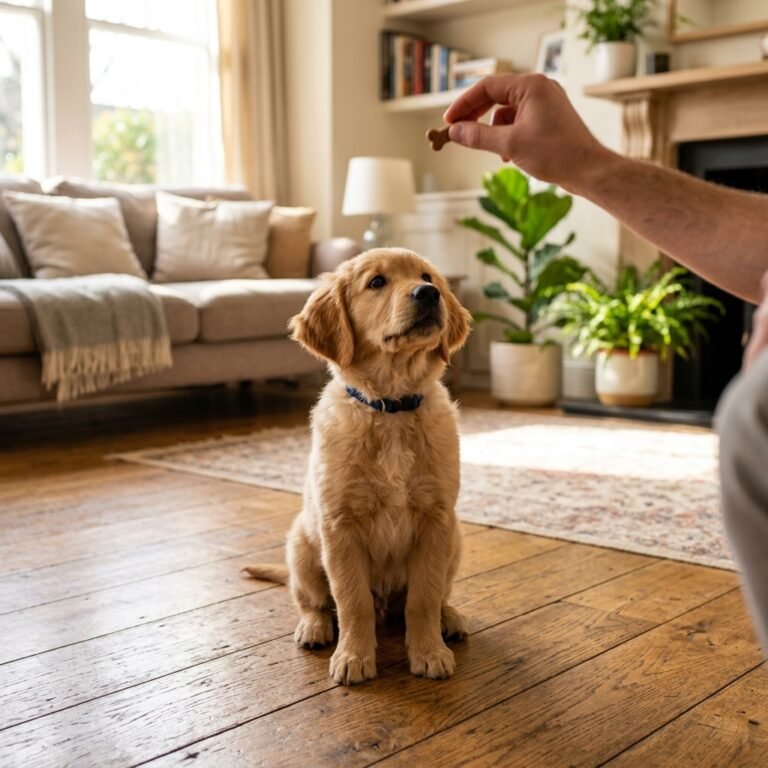
Positive reinforcement is the most effective, scientifically backed method for training dogs. However, the timing of the reward is critical. The reward must be given within one to two seconds of the desired behavior. Teach your family the Mark and Reward system:
- Ask: Give the command clearly and cheerfully (e.g., “Sit”).
- Mark: The exact second the puppy’s bottom hits the floor, say your marker word (like “Yes!”) or click your clicker.
- Reward: Deliver the treat immediately after marking the behavior.
Ensure that children are taught how to offer treats safely, with a flat palm, to avoid accidental nips from an over-eager puppy.
Phase 3: Handling Unwanted Behaviors
How your family handles bad behavior is just as important as how you reward good behavior.
Never use physical punishment, yelling, or rubbing a puppy’s nose in a mess. This only teaches the puppy to fear you and hides the behavior rather than fixing it.
Instead, use redirection and management. If the puppy is chewing on a shoe, calmly say “Drop It,” trade them the shoe for a high-value chew toy, and praise them for chewing the toy. If the puppy is biting hands during play, the family rule must be that all play stops immediately. Stand up, cross your arms, and look away for 10 seconds. The puppy will quickly learn that biting makes the fun stop.
Troubleshooting Common Family Training Mistakes
Overcoming the Hurdles
Even with the best-laid plans, families are going to hit some bumps in the road. Life gets busy, people get tired, and sometimes it is just easier to let a bad habit slide. But recognizing these common pitfalls is the first step to overcoming them. Let us troubleshoot some of the most frequent family training mistakes so you can stay on track.
The Family Softie
Every family has one—the person who simply cannot resist those big puppy dog eyes. They sneak table scraps, they let the puppy on the couch when no one is looking, and they refuse to enforce the rules because they feel bad. If this is happening, you need to have a gentle but firm conversation. Remind the softie that inconsistency actually causes the puppy stress. A confused dog is an anxious dog. Show them how to give affection in productive ways, like through grooming, playing fetch, or running a training session with treats. Redirect their love into activities that build the dog’s confidence rather than undermining the training.
The Inconsistent Teenager
Teenagers mean well, but they can be easily distracted by phones, friends, or homework. If a teenager is responsible for a potty break and forgets, the puppy pays the price with an indoor accident. To solve this, make the puppy schedule highly visible and set alarms on smartphones. If the teenager is playing too rough with the pup and encouraging biting, step in and demonstrate appropriate play using long tug toys that keep teeth away from skin.
When Grandma and Grandpa Visit
Extended family members often feel that house rules do not apply to them. They want to spoil the new puppy! Before guests arrive, send a polite text outlining your top three puppy rules. For example: We are so excited for you to meet the puppy! Please help us with his training by ignoring him if he jumps, only feeding him his specific dog treats (which we will provide!), and keeping shoes off the floor. Managing the environment by keeping the puppy on a leash during the initial greeting can also prevent guests from accidentally encouraging bad habits.
Remember, training a family puppy is a marathon, not a sprint. There will be days where it feels like you are taking two steps forward and one step back. But if you stick to your unified blueprint, keep your communication clear, and support each other, you will get through the puppy phase and enjoy decades with a wonderful, well-mannered canine companion.
Conclusion
Training a puppy is undoubtedly a lot of work, but when you approach it as a unified family team, the process transforms from a frustrating chore into an incredibly rewarding bonding experience. By eliminating mixed signals, agreeing on a clear vocabulary, and sticking to a predictable schedule, you are setting your puppy up for absolute success. Remember to be patient—both with your new furry friend and with each other. Mistakes will happen, but as long as you return to your core training blueprint, you will stay on the right path. Consistency is the key that unlocks your dog’s true potential. Stick to the plan, celebrate the small victories, and look forward to a lifetime of love and companionship with your perfectly trained family dog!