Stop Puppy Jumping On Screen Door: 4 Easy Ways To Save Your Screens
Hey there, fellow dog lovers! If you are reading this, chances are you are all too familiar with that dreaded sound: the sharp scratching of little claws tearing into your patio screen door. One minute you are enjoying a beautiful breeze, and the next, your enthusiastic puppy is launching themselves at the mesh like it is an Olympic sport. As savvy dog owners, we know our pups are not trying to be destructive on purpose. They are just overwhelmed with excitement, curiosity, or the desperate urge to chase that cheeky squirrel in the backyard. But understanding their motivation does not make replacing a torn screen any less frustrating or expensive.
Welcome to your ultimate guide on reclaiming your home’s entryways. Training your puppy to respect boundaries, especially fragile ones like screen doors, is a crucial step in their behavioral development. It is about teaching impulse control, establishing clear communication, and keeping them safe from potentially pushing through and getting lost or injured. In this comprehensive guide, we are going to dive deep into four incredibly effective, fear-free methods to stop your puppy from jumping on the screen door. We will cover everything from mastering essential commands to setting up foolproof environmental management. Grab a handful of your dog’s favorite high-value treats, take a deep breath, and let us get started on saving those screens!
Understanding the Urge: Why Your Puppy Attacks the Screen Door
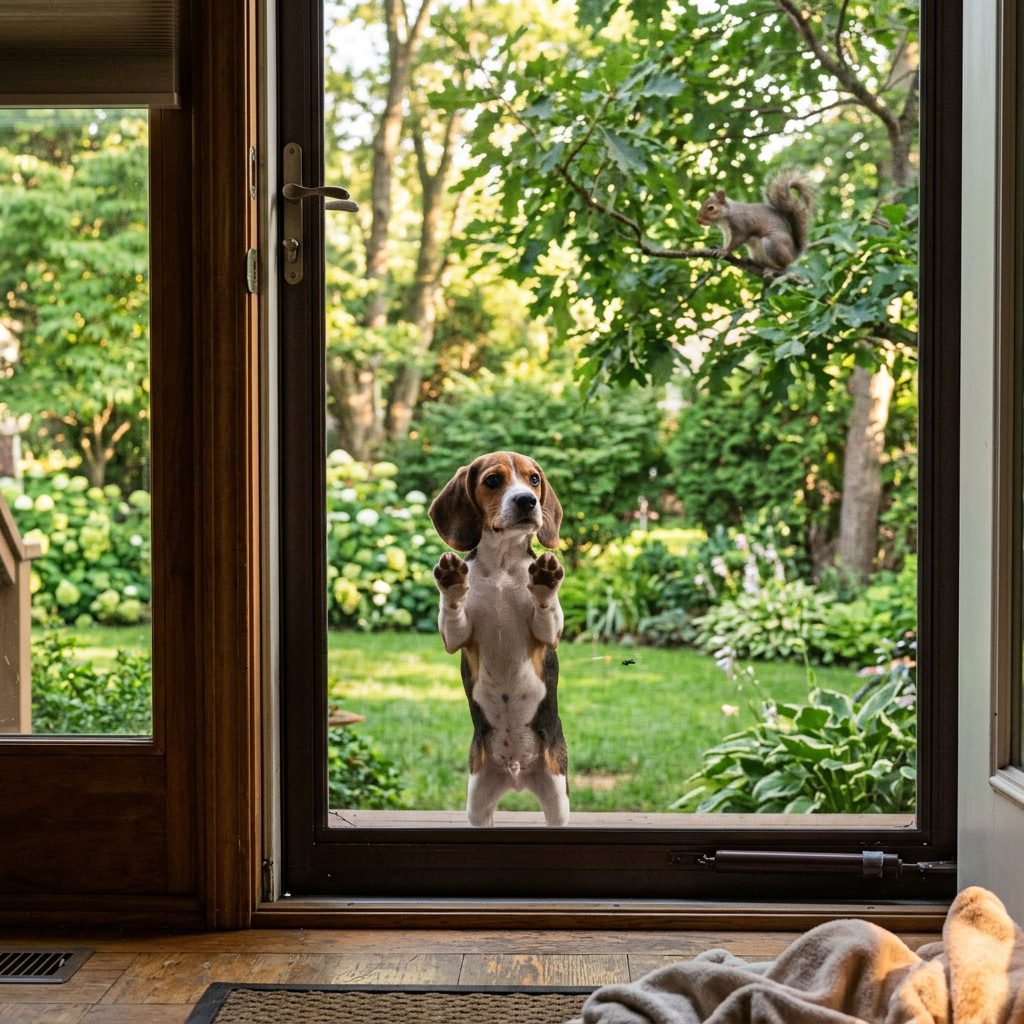
Before we can effectively stop the jumping, we need to put on our canine behaviorist hats and figure out exactly why your puppy is treating your screen door like a trampoline. Puppies experience the world through motion, scent, and immediate desires. A screen door is incredibly frustrating to a dog because it offers full visibility and airflow of the exciting outdoors, but presents an invisible, confusing physical barrier. They can see the birds, smell the fresh cut grass, and hear the neighborhood kids, but they cannot get to them. This creates a state of high arousal and barrier frustration.
Common Triggers for Screen Jumping
- Prey Drive: Catching sight of a squirrel, rabbit, or bird triggers an instinctual urge to chase.
- Separation Anxiety or FOMO: If you are outside on the patio and they are inside, they want to be with you.
- Potty Urgency: Sometimes, frantic jumping is a poorly communicated signal that they desperately need a bathroom break.
- Greeting Excitement: Seeing visitors or family members approach the door causes them to jump up in anticipation.
Understanding your puppy’s specific trigger is half the battle. Once you know what sets them off, you can anticipate the jump and redirect the behavior before those paws ever touch the mesh.
To help you decode your puppy’s behavior, here is a quick breakdown of common triggers and how you should immediately respond to set the stage for our training methods.
| The Trigger | Your Puppy’s Goal | Your Immediate Action |
|---|---|---|
| Seeing a squirrel or bird | Chase and catch the prey | Redirect their attention with a high-value squeaky toy or treat |
| You are outside without them | Reunite with their favorite human | Ignore the jumping; only open the door when all four paws are on the floor |
| Needing to go potty | Get outside to relieve themselves | Teach them to ring a bell or sit by the door instead of jumping |
| Guests arriving | Say hello and get attention | Put them on a leash or in a “Place” command before opening the door |
Way 1: Master the Off Command and Redirection
The very first tool you need in your training toolkit is a solid Off command. Notice that we say “Off” and not “Down.” In dog training, “Down” should strictly mean “lie down on the floor,” while “Off” means “remove your paws from whatever they are currently resting on.” Consistency in your vocabulary is key for a savvy dog owner. Teaching “Off” requires perfect timing and high-value rewards.
Step-by-Step Guide to the Off Command
- Catch the Behavior: Observe your puppy around the screen door. The moment they jump up, calmly but firmly say “Off.” Do not yell or sound angry, as this can either scare them or be misinterpreted as you joining in on their excitement.
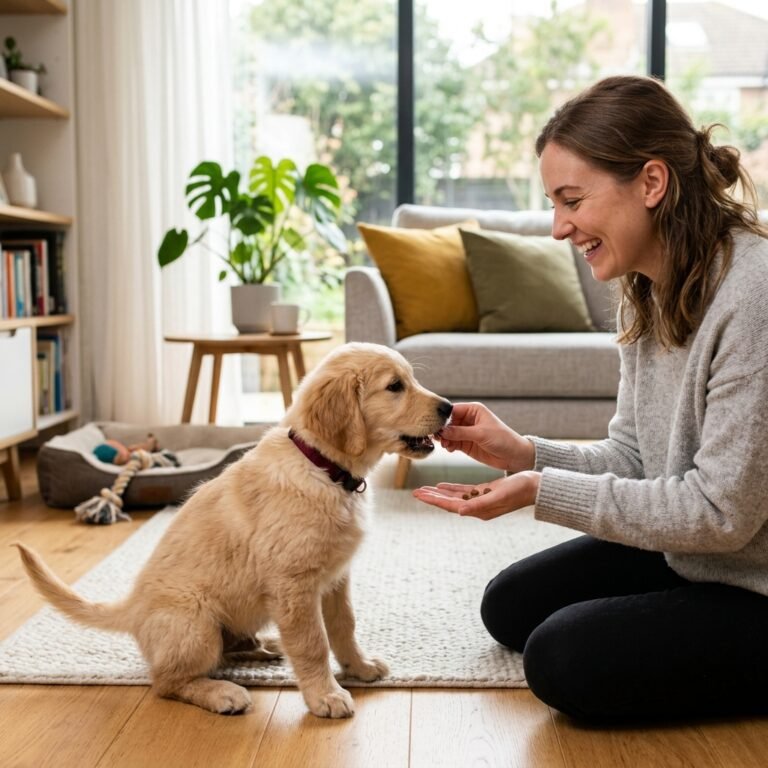
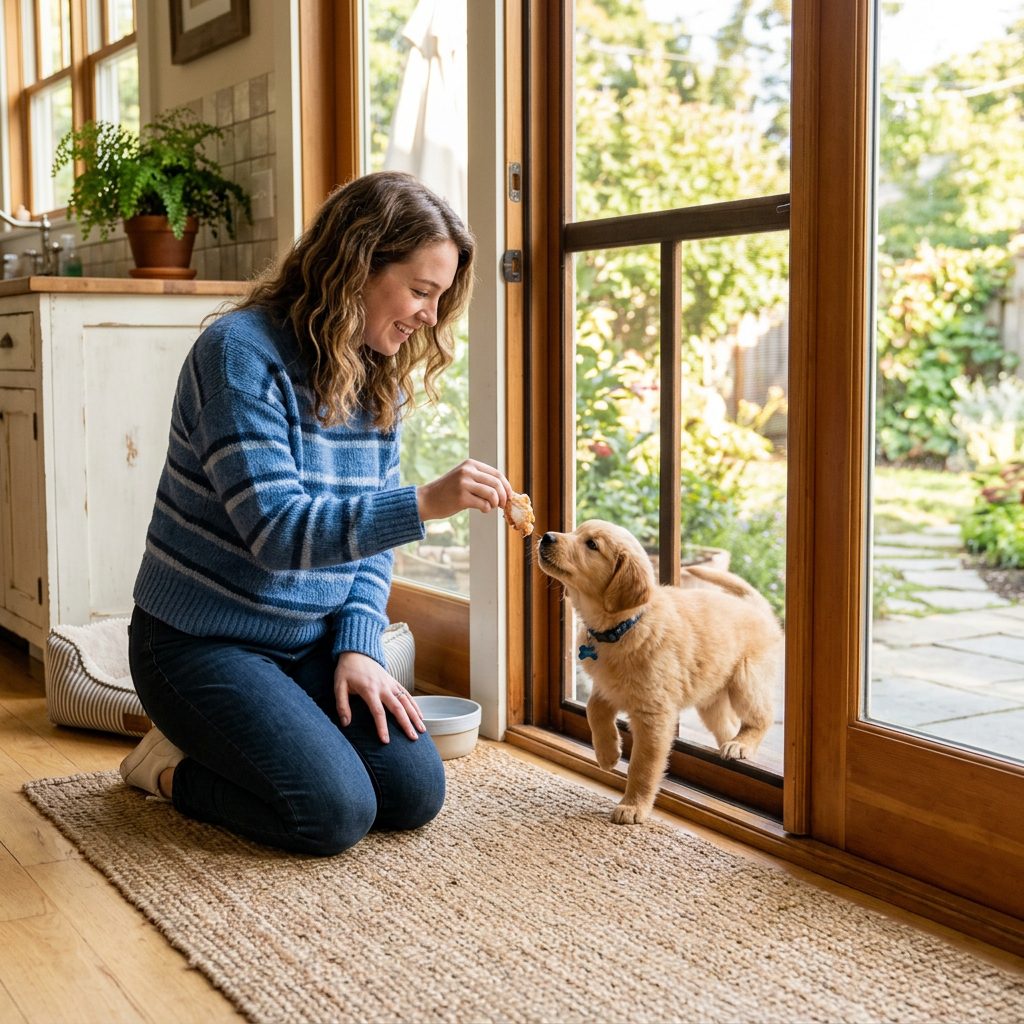
- Guide Them Down: If they do not immediately drop down, take a high-value treat (like a tiny piece of boiled chicken or hot dog) and put it right in front of their nose. Slowly lure their nose down toward the floor. Where the head goes, the body follows.
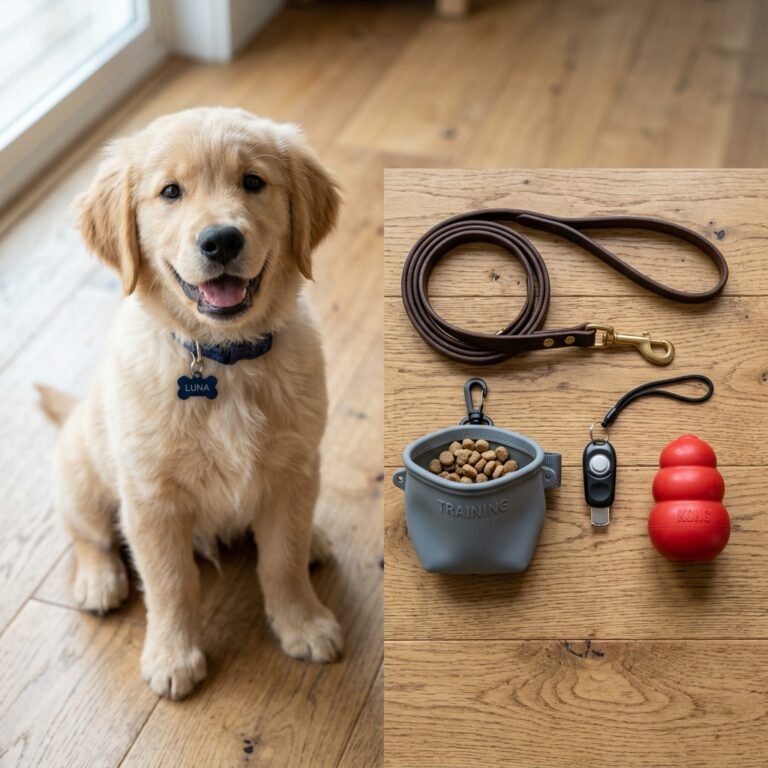
- Reward the Floor: The exact millisecond all four paws touch the ground, say “Yes!” or click your training clicker, and give them the treat.
- Redirect: Once they are on the floor, immediately redirect them to an appropriate activity. Hand them a chew toy or ask them to perform a different command like “Sit.”
It is crucial to avoid a common training trap known as the “yo-yo effect.” This happens when your puppy learns that jumping up, and then jumping off, earns them a treat. They will start jumping on the door just so you will tell them “Off” and feed them. To prevent this, you must transition to rewarding them for not jumping in the first place. Anticipate the jump. When they run toward the door and stop without jumping, throw a massive treat party. Show them that four paws on the floor is the most rewarding position in the house.
Way 2: Desensitize Your Puppy to the Door
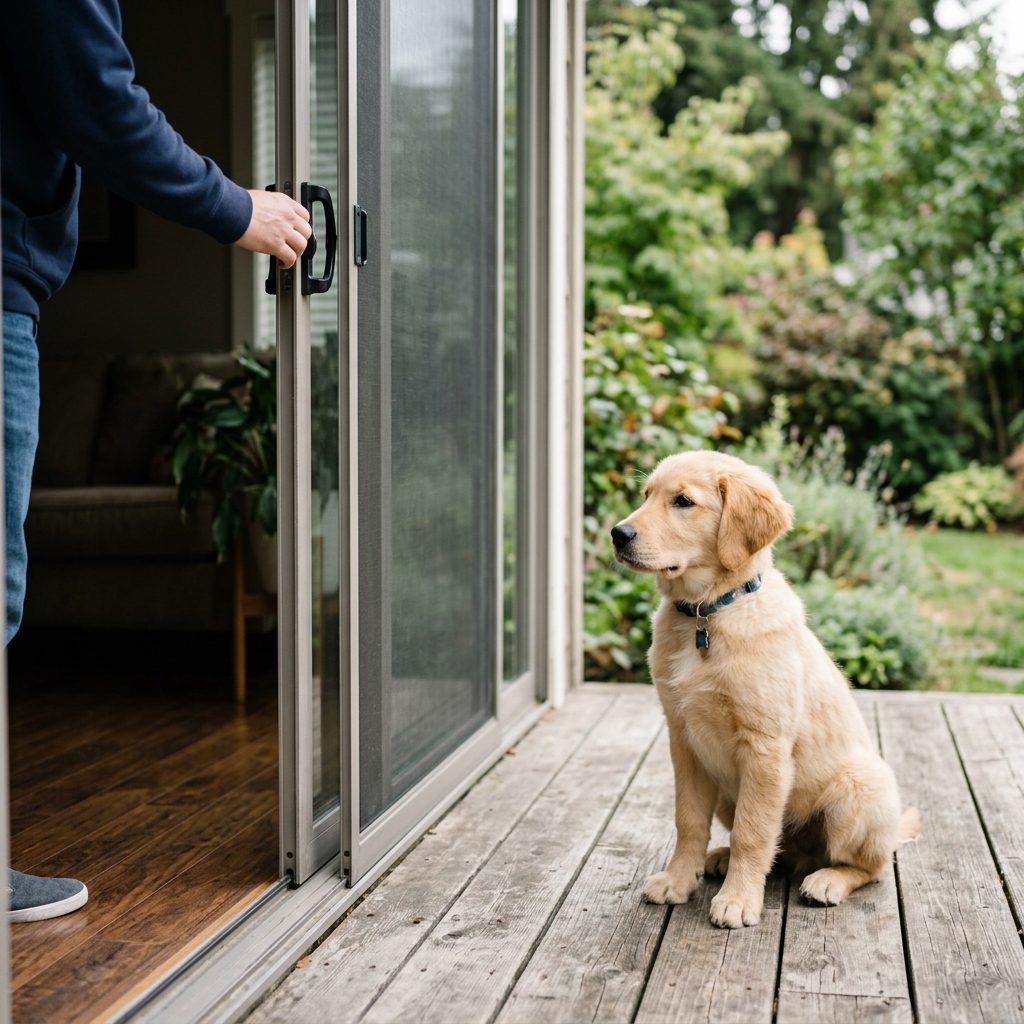
Often, the screen door itself becomes a trigger. The sound of it sliding open, the click of the latch, or the sudden rush of air can send a puppy into a frenzy. Desensitization is a powerful behavioral modification technique that changes your puppy’s emotional response to the door from “wild excitement” to “calm neutrality.” This requires patience, but it is incredibly effective for long-term peace in your home.
The Desensitization Process
Start this training when your puppy is already somewhat tired, perhaps after a long walk or a play session. A tired puppy is much easier to train than one bursting with pent-up energy.
- Step 1: The Latch. Walk up to the door and simply touch the handle. If your puppy stays calm, toss them a treat. Next, click the latch without opening the door. Treat for calmness. Repeat this until the sound of the latch is boring to them.
- Step 2: The Slide. Slide the door open just one inch, then immediately close it. Do not let the puppy squeeze through. If they stay sitting or standing calmly, reward them. Gradually increase how far you open the door.
- Step 3: The Threshold. Once you can open the door fully without your puppy rushing it, teach them that the open door is an invisible wall. Stand in the doorway and claim the space. If they try to cross, gently step into their path to block them and say “Wait.” When they back off and sit, reward them.
The goal of desensitization is to make the screen door a non-event. The more boring the door becomes, the less likely they are to jump on it out of excitement.
Remember to practice this from both sides of the door. Puppies are notoriously bad at generalizing. Just because they know not to jump from the inside does not mean they understand the rules from the outside patio looking in. Spend time outside with the door closed, rewarding them for sitting calmly on the patio rather than pawing at the mesh to get back inside.
Way 3: Implement Physical Barriers and Screen Protectors
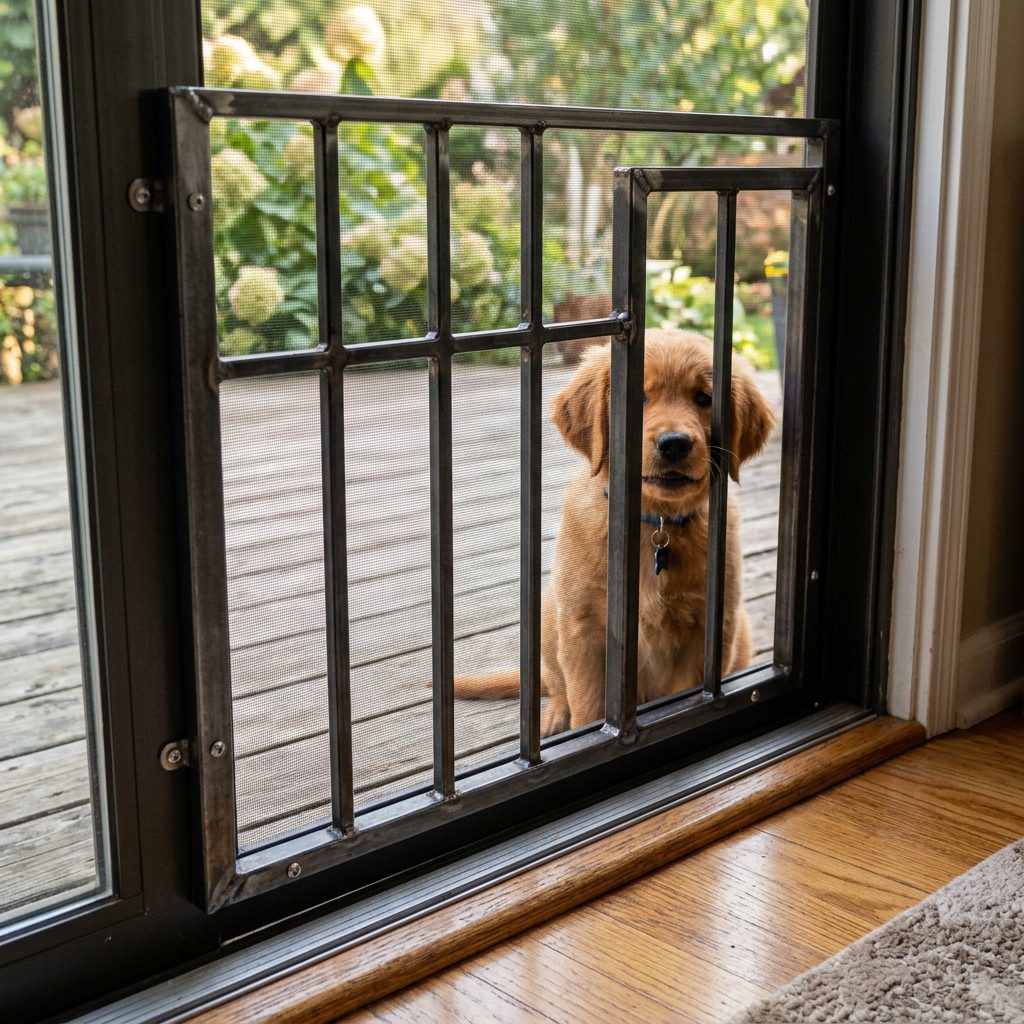
Even the best training takes time, and puppies are bound to make mistakes while they are learning. As a savvy dog owner, you need to manage their environment to prevent them from rehearsing the bad behavior. Every time your puppy jumps on the screen and gets to watch the squirrel, the behavior is inherently reinforced. Management means setting up physical barriers to protect your property while the training takes root.
Choosing the Right Protective Gear
There are several fantastic products on the market designed specifically to pet-proof your screen doors. Depending on the size of your dog and the layout of your home, you can mix and match these solutions to find what works best for you.
| Barrier Type | Pros | Cons | Best For |
|---|---|---|---|
| Pet Screen Mesh | Highly durable, resists tears from sharp claws, looks like normal screen | Requires removing the old mesh and installing the new one | Determined scratchers and large breed puppies |
| Screen Door Grilles | Provides a solid metal barrier over the lower half of the door | Can look a bit industrial, might block some lower visibility | Heavy jumpers who put their full weight on the door |
| Freestanding Baby Gates | Completely blocks access to the door area, easy to move | Inconvenient for humans to step over constantly | Young puppies in the early stages of training |
| Magnetic Screen Flaps | Allows the pup to walk through without jumping or pawing | Does not keep the dog inside if you want them contained | Homes where dogs have free indoor/outdoor access |
If you are looking for a quick DIY fix while waiting for a permanent solution, you can use a decorative piece of lattice or a sturdy piece of clear plexiglass temporarily attached to the bottom half of the door. This physically blocks the claws from reaching the delicate mesh. However, remember that management is not a substitute for training. These barriers are training wheels. The ultimate goal is to remove the barriers once your puppy has mastered their impulse control and learned the “Off” and “Place” commands.
Way 4: Reinforce Calm Behavior with the Place Command
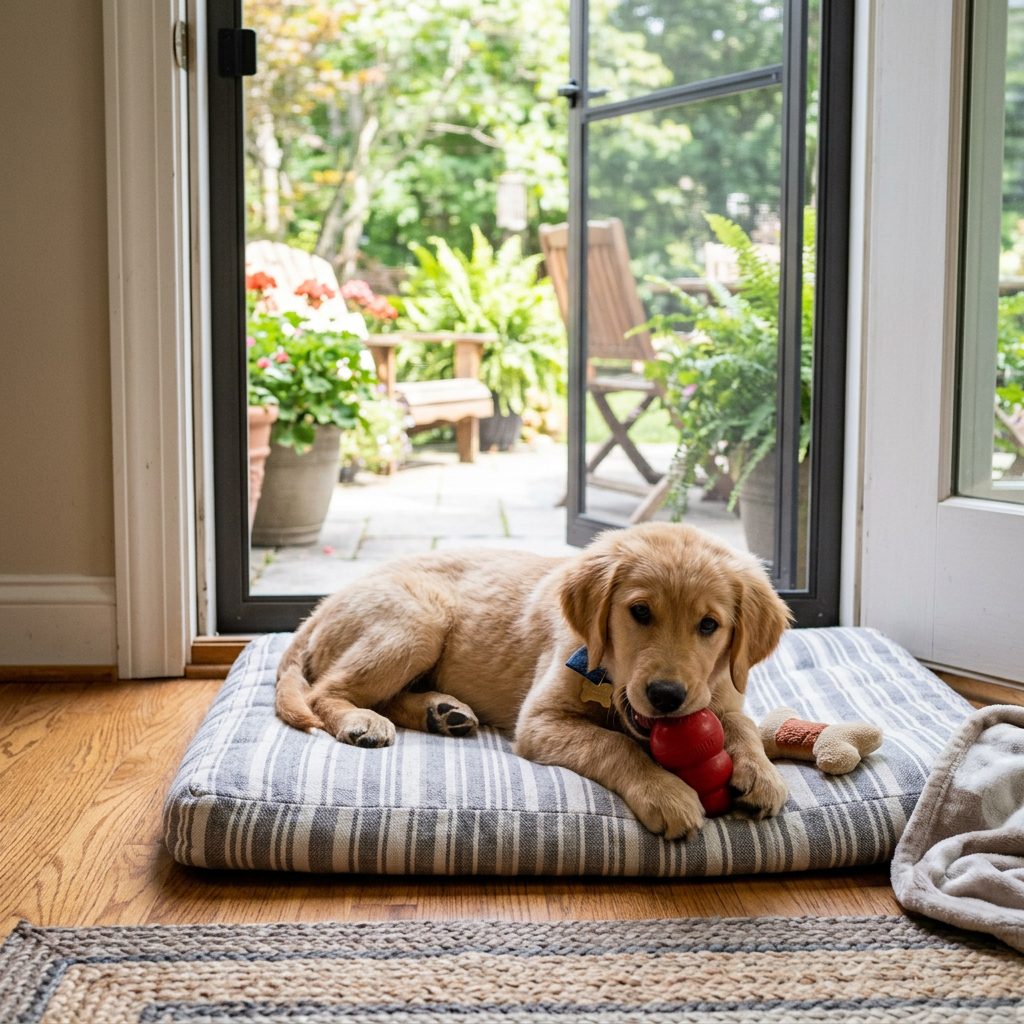
One of the most profound shifts in dog training is moving from telling your dog what not to do, to telling them what to do instead. If you do not want your puppy jumping on the screen door, where do you want them to be? The answer is usually: resting calmly on a bed or a mat. This is where teaching the Place command becomes your secret weapon. It gives your puppy a designated safe zone where they know they will be rewarded for relaxing.
Teaching the Place Command
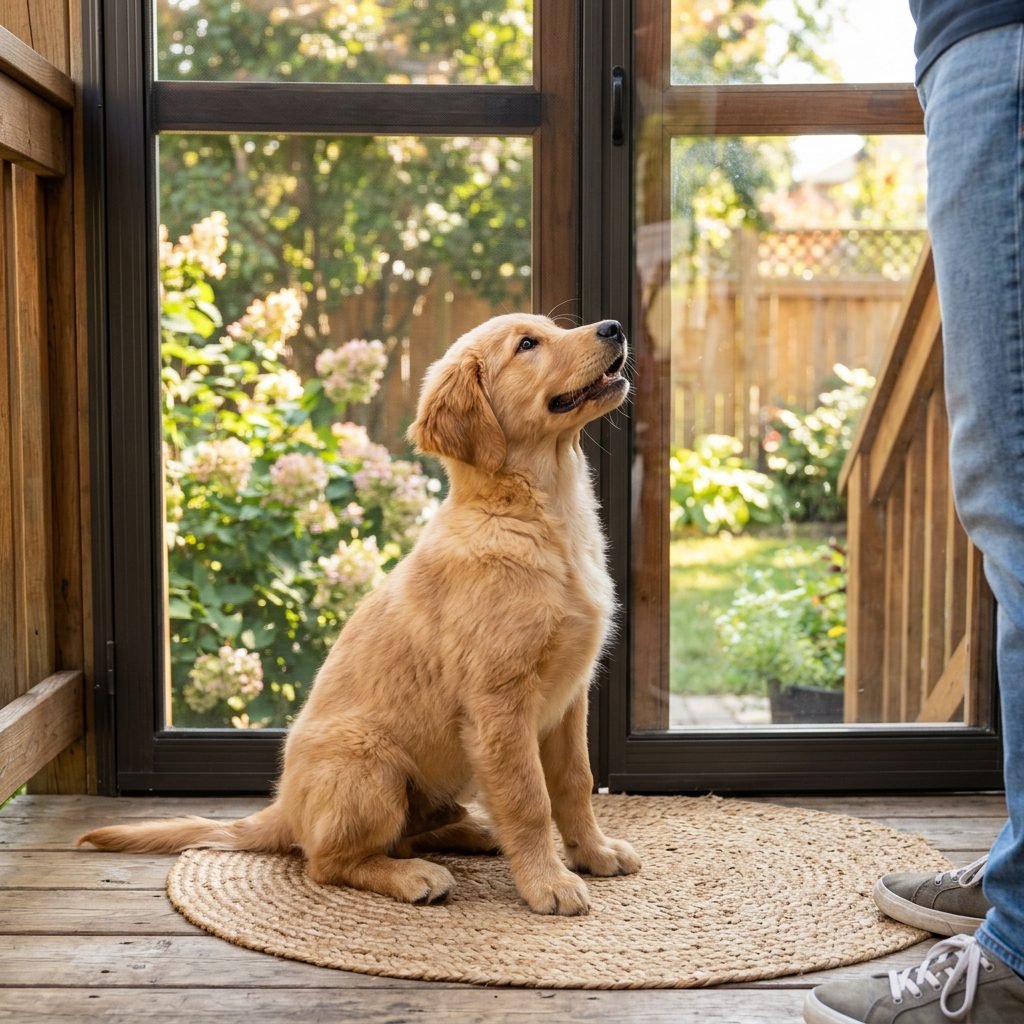
To start, you will need a dog bed, a small rug, or a raised cot. Position it a few feet away from the screen door—close enough that they can see outside, but far enough that they cannot touch the door.
- Introduce the Mat: With your puppy on a leash, lure them onto the mat with a treat. As soon as all four paws are on the mat, say “Place” and give them the treat.
- Encourage a Down: Once they are comfortable going to the mat, ask them to lie down. A dog lying down is naturally calmer than a dog standing up. Reward them generously for staying in the down position on their mat.
- Add Duration: Slowly increase the time they must stay on the mat before getting a treat. Start with 5 seconds, then 10, then 30. If they get up, calmly guide them back.
- Add Distractions (The Screen Door): This is the crucial step. Put your puppy in “Place.” Walk over to the screen door and touch the handle. If they stay on the mat, return and reward them. Gradually build up to opening the screen door, walking outside, and coming back in, all while they remain on their mat.
The “Place” command acts as an off-switch for your dog’s brain. It teaches them that they don’t need to patrol the door or chase every distraction. Their only job is to chill out on their bed.
With consistent practice, your puppy will learn that the appearance of a squirrel or the sound of the doorbell is actually a cue to run to their “Place” mat, rather than rushing the screen door. You are fundamentally rewiring their reaction to triggers with positive reinforcement.
Troubleshooting: When the Jumping Just Won’t Stop
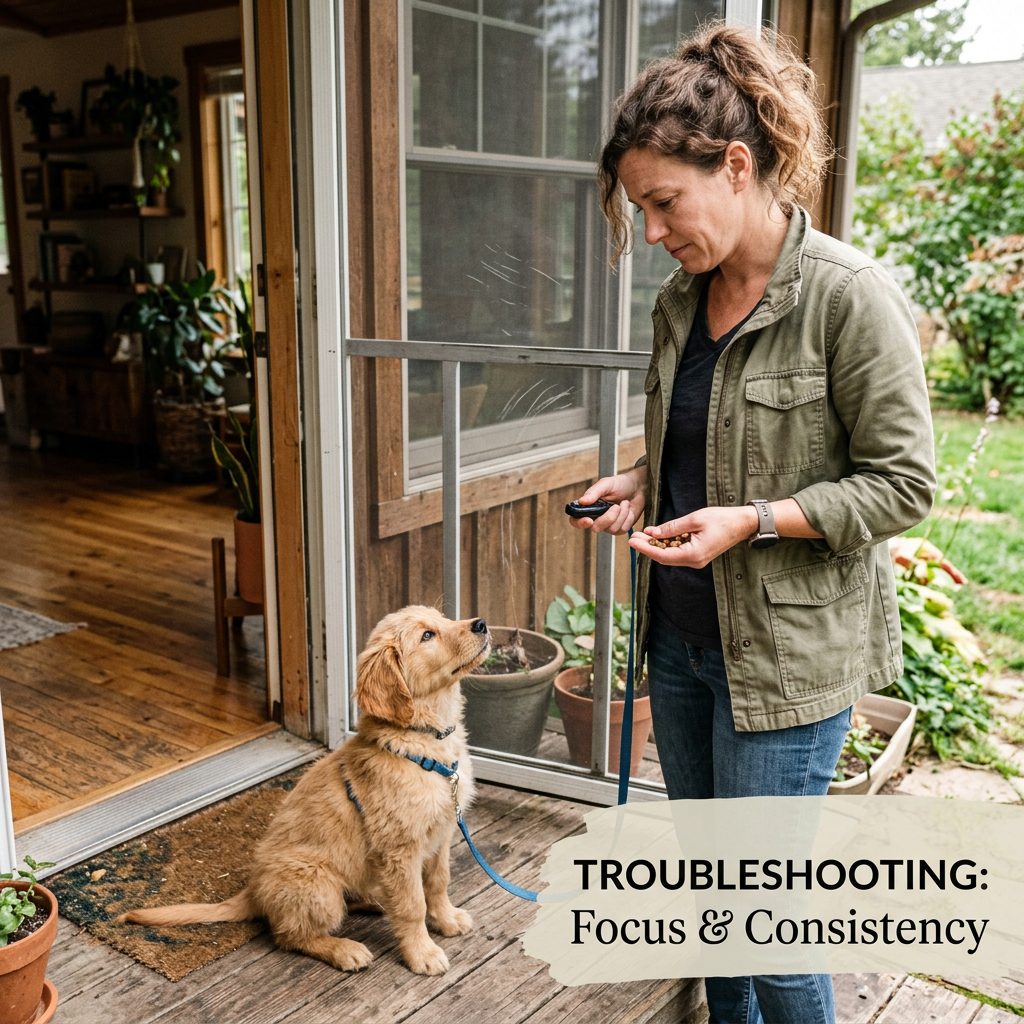
Even the savviest dog owners hit roadblocks during training. Puppies are living, breathing creatures with their own minds, and progress is rarely a straight line. If you feel like you are doing everything right but your puppy is still launching themselves at the screen door, do not despair. Let us troubleshoot some of the most common training setbacks and how to overcome them.
The Extinction Burst
Have you noticed that the jumping actually got worse after you started training? This is a well-documented psychological phenomenon called an “extinction burst.” When a behavior that used to work (jumping to get your attention or get out the door) suddenly stops working, the puppy will try harder before they give up. They think, “Maybe I just need to jump higher and scratch louder!” Stay strong. Do not give in during an extinction burst. If you yield and open the door, you have just taught them that they simply need to throw a bigger tantrum to get what they want.
Inconsistency in the Household
Dogs are incredibly context-specific learners. If you are strictly enforcing the “four paws on the floor” rule, but your partner or your kids let the puppy jump on the screen door when you aren’t around, the puppy will remain confused. Sit down with everyone in your household and agree on the rules. Consistency is the magic ingredient in dog training. Every single interaction with the door must follow the same protocol.
Lack of Physical and Mental Exercise
A tired dog is a good dog. If your puppy is bouncing off the walls and attacking the screen door, ask yourself if their fundamental needs are being met. Are they getting enough rigorous physical exercise? Are they getting mental stimulation through puzzle toys, sniffaris, or training sessions? Often, destructive or hyperactive behavior around the house is simply a symptom of boredom and pent-up energy. Before you start a training session by the door, ensure your pup has had a good walk or a game of fetch to take the edge off.
- Quick Tip: Keep a jar of treats right next to the screen door. This ensures you are always ready to capture and reward calm behavior the second it happens, without having to run to the kitchen and miss the training window.
Conclusion
Training your puppy to stop jumping on the screen door is a journey that requires patience, consistency, and a good sense of humor. Remember, you are not just saving your mesh screens from destruction; you are teaching your puppy valuable life skills like impulse control, emotional regulation, and boundary awareness. By understanding their triggers, mastering the “Off” and “Place” commands, utilizing smart physical barriers, and desensitizing them to the door itself, you are setting your furry best friend up for absolute success. Stay positive, keep those high-value treats handy, and celebrate the small victories along the way. Before you know it, you will be enjoying the fresh breeze through a pristine screen door, with a calm, happy puppy resting quietly by your side. You’ve got this!