Stop Puppy Chasing Family Cat: 5 Rules For A Peaceful Multi-Pet Home
Welcome, savvy pet parents! If you are reading this, chances are your household currently feels less like a peaceful sanctuary and more like a chaotic episode of Tom and Jerry. You brought home an adorable, floppy-eared puppy, expecting instant best-friendship with your resident feline. Instead, your puppy has decided the cat is the most exciting squeaky toy ever invented, and your cat is plotting their revenge from the top of the kitchen cabinets.
First of all, take a deep breath. You are not alone, and this is completely normal behavior. Puppies explore the world through movement and play, and to a puppy, a darting cat is an irresistible invitation for a game of chase. However, just because it is natural does not mean it is acceptable. Allowing your puppy to chase the cat can lead to severe stress for your feline friend, potential injury for both pets, and a deeply ingrained bad habit that becomes incredibly difficult to break as your dog grows larger and faster.
As responsible, proactive dog owners, it is our job to step in, act as the referee, and teach our puppies the house rules. Creating harmony between a dog and a cat requires patience, consistency, and a solid understanding of canine behavior. In this comprehensive guide, we are going to dive into the exact framework you need to restore the peace. We will explore the psychology behind the chase, the essential management tools you need, and the step-by-step training techniques that actually work. Grab a cup of coffee, get comfortable, and let us dive into the 5 golden rules to stop your puppy from chasing the family cat.
Rule 1: Understand Why Your Puppy Chases (Prey vs. Play)
Before we can fix the behavior, we have to understand the motivation behind it. Puppies do not chase cats because they are inherently ‘bad’ or aggressive; they chase them because they are driven by instinct. But not all instincts are the same. As a savvy dog owner, you need to differentiate between play drive and prey drive. Understanding this distinction will dictate how you approach your training and how carefully you need to manage their interactions.
The Play Drive
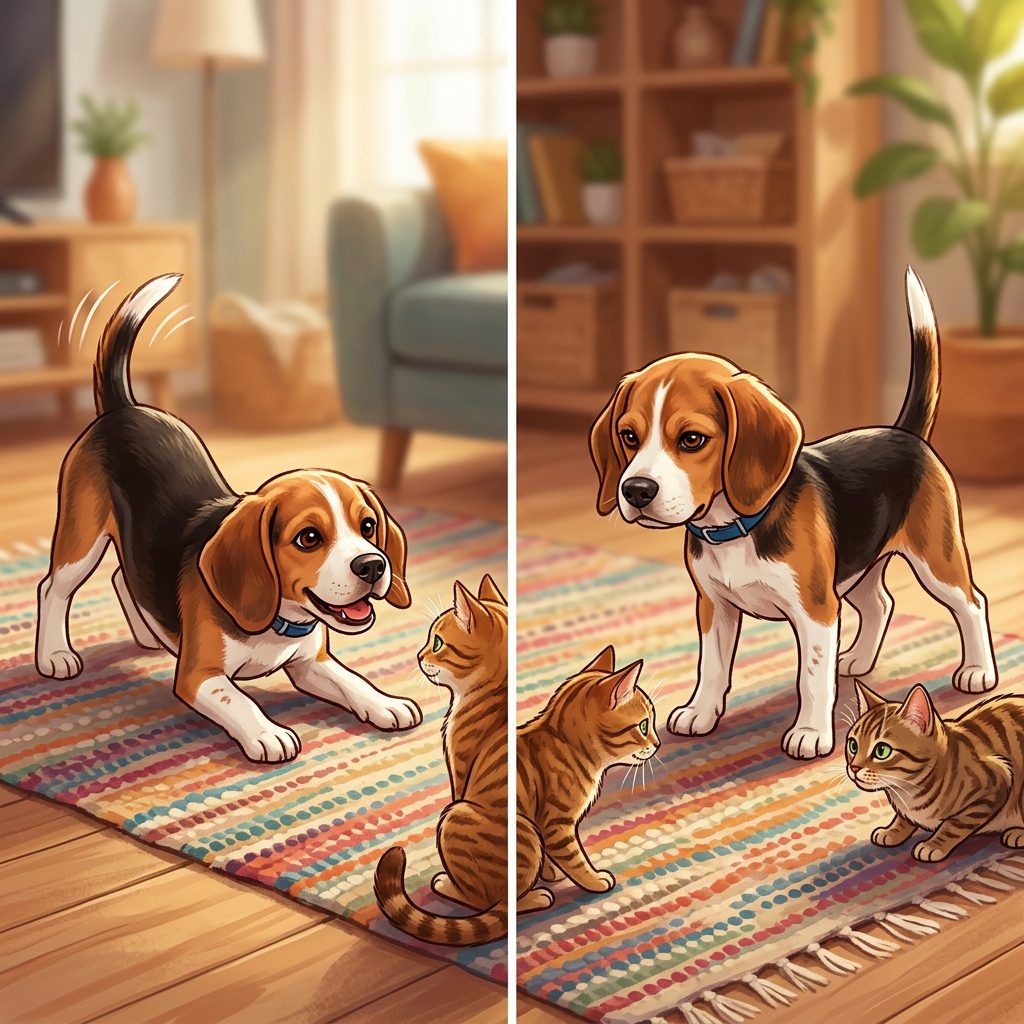
Most young puppies are motivated by play. When a puppy wants to play, their body language is usually loose and wiggly. They might drop into a ‘play bow’ (front legs flat on the ground, rear end up in the air), bark excitedly, or bounce around the cat. In their minds, the cat is just a funny-looking sibling who plays hard to get. While this is innocent, a cat does not speak ‘dog.’ To a cat, a bounding puppy is a terrifying predator, and their instinct is to run—which, unfortunately, just triggers the puppy to chase them more.
The Prey Drive
Prey drive is a deeper, more primal instinct. It is the sequence of behaviors inherited from their wolf ancestors: search, stalk, chase, grab, bite, and dissect. Certain breeds, like terriers, sighthounds, and herding dogs, have highly amplified prey drives. If your puppy is exhibiting prey drive, their body language will look very different from play. They will become intensely focused, their body will stiffen, they may freeze and stare (the ‘hard stare’), and their movements will be calculated and stealthy before they launch into a chase. This type of chasing is significantly more dangerous and requires immediate, strict intervention.
Play vs. Prey: Spotting the Difference
Here is a quick reference guide to help you read your puppy’s body language when they are around the cat:
| Behavioral Cue | Play Drive (Wants to play) | Prey Drive (Wants to hunt/herd) |
|---|---|---|
| Body Posture | Loose, wiggly, bouncy | Stiff, rigid, lowered center of gravity |
| Eye Contact | Soft eyes, looks away occasionally | Hard, unblinking stare, hyper-focused |
| Vocalization | High-pitched barks, playful growls | Often completely silent, or low whining |
| Movement | Exaggerated, playful bows, jumping | Slow stalking, freezing, sudden explosive lunges |
| Reaction to Interruption | Easily distracted by a toy or your voice | Ignores you completely, fixated on the cat |
Expert Tip: If you notice signs of intense prey drive, never leave your puppy and cat alone together unsupervised. Management and professional training are absolute necessities to prevent a tragic accident.
Rule 2: Master Environmental Management First
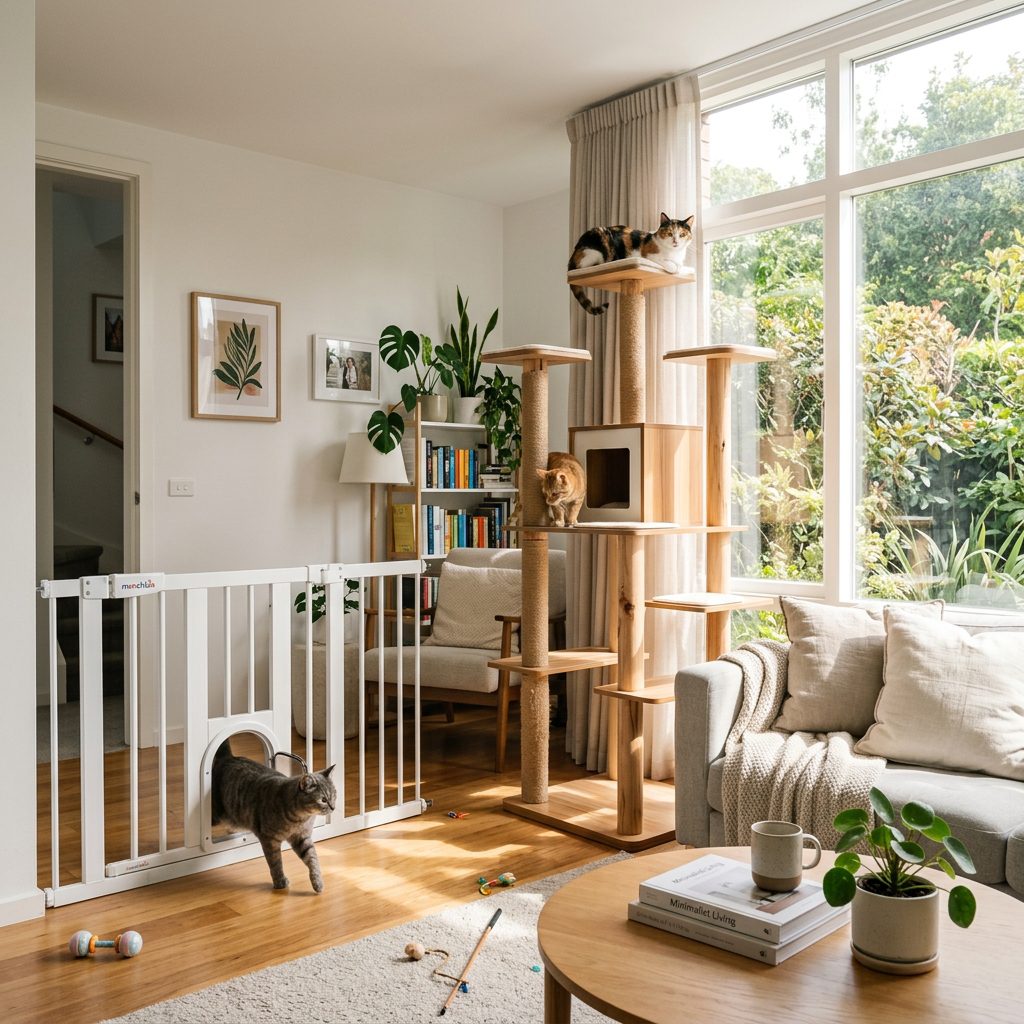
When it comes to modifying animal behavior, management is always your first line of defense. You cannot train a puppy if you cannot control their environment. Every single time your puppy successfully chases the cat, the behavior is self-rewarding. The thrill of the chase releases dopamine in their brain, making them want to do it again and again. To break the cycle, you must prevent the chase from happening in the first place.
Create Vertical Escape Routes for the Cat
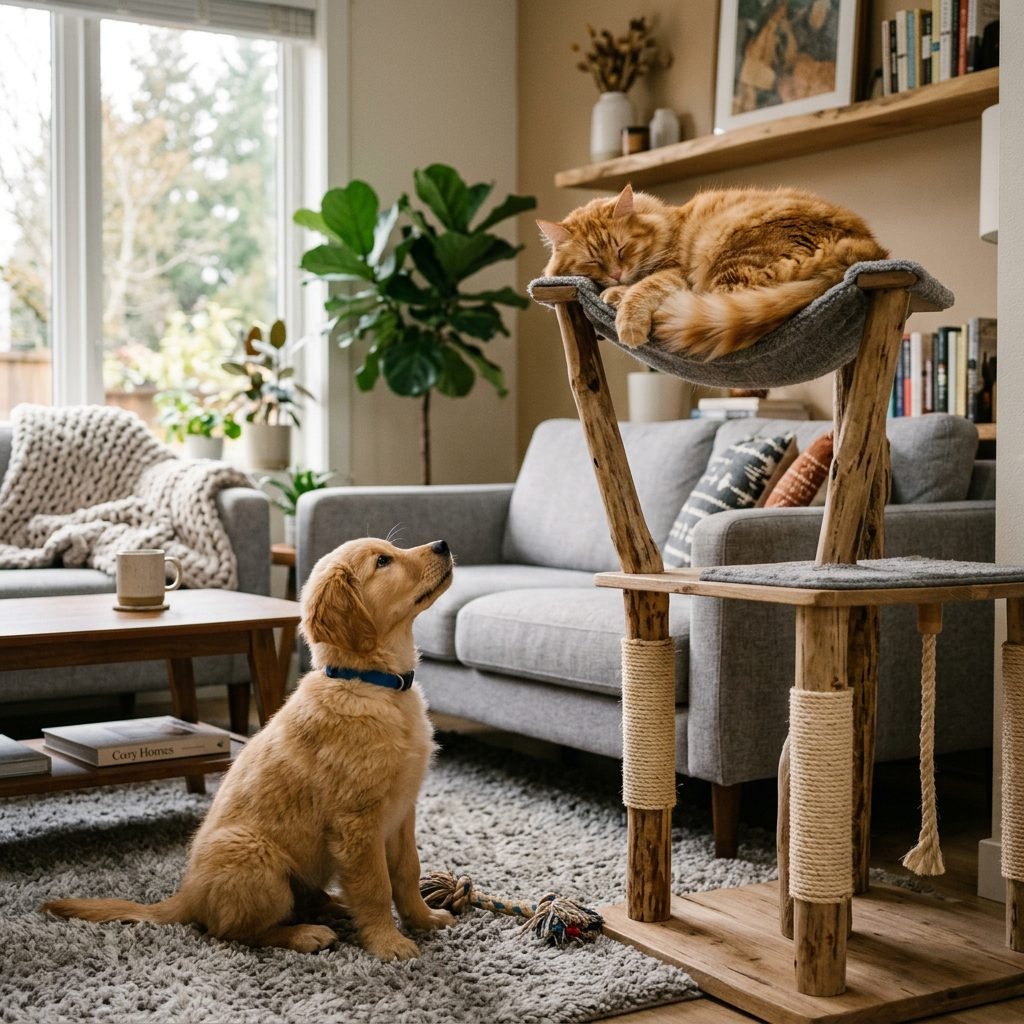
Cats feel safest when they are up high, observing their territory from a vantage point where a dog cannot reach them. If your cat is forced to navigate the house on the floor, they will constantly feel vulnerable, leading to running, which triggers the puppy. Invest in tall, sturdy cat trees, install cat shelves along your walls, or simply clear off the top of a bookshelf. Ensure that in every room the pets share, the cat has an immediate, accessible path to high ground.
Utilize Baby Gates and Safe Zones
Your cat needs a designated ‘safe zone’ where the puppy is strictly forbidden. This could be a spare bedroom, the basement, or a large bathroom. Use extra-tall baby gates to block off these areas. If your puppy is small enough to squeeze through the bars of a standard gate, look for gates with vertical slats or mesh. Some fantastic pet gates even come with a tiny, cat-sized door at the bottom that allows the feline to pass through while keeping the dog out.
The Leash is Your Best Friend Indoors
Until your puppy has mastered impulse control, they should not have free roam of the house while the cat is active. Keep a lightweight, drag leash (also known as a house line) on your puppy when they are out of their crate or playpen. This gives you a safe, immediate way to step on the leash and stop a chase before it starts, without having to grab at your puppy’s collar, which can cause leash reactivity or fear.
Essential Management Tools Checklist
- Sturdy Baby Gates: Preferably with a walk-through door for humans and a small pass-through for cats.
- House Line/Drag Leash: A cheap, lightweight leash with the handle cut off (to prevent snagging on furniture).
- Vertical Space: Cat trees, window perches, and wall shelves.
- High-Value Treats: Keep jars of irresistible treats (like freeze-dried liver or boiled chicken) in every room to quickly reward the puppy for ignoring the cat.
Rule 3: Teach Solid Impulse Control Commands
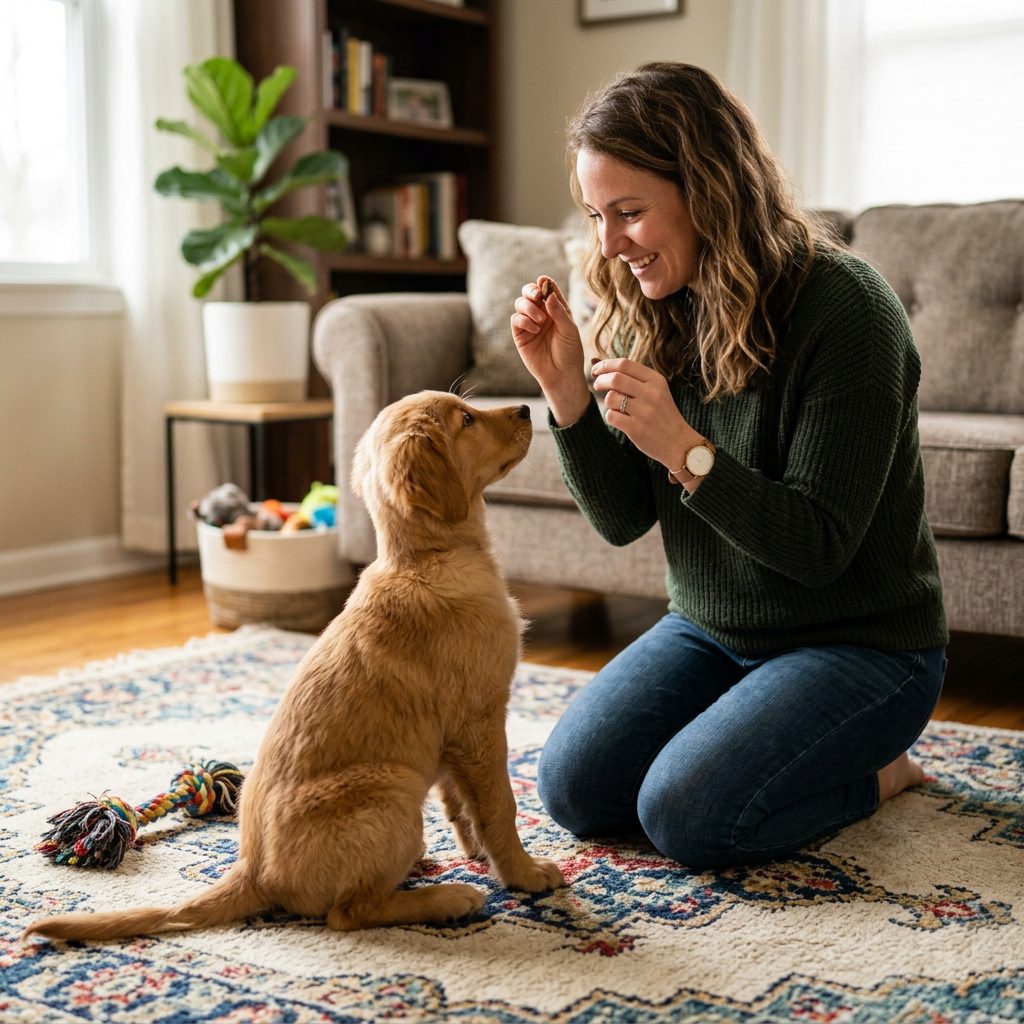
Once you have managed the environment to prevent rehearsals of the bad behavior, it is time to actively train the good behavior. Puppies are not born with impulse control; it is a muscle that must be built over time. The two most critical commands you can teach a dog in a multi-pet household are ‘Leave It’ and ‘Look At Me’ (Watch Me).
Step-by-Step: The ‘Leave It’ Command
The ‘Leave It’ command tells your puppy that whatever they are focusing on is off-limits, and they will get something much better if they disengage. Do not start teaching this with the cat! Start with something boring, like a piece of dry kibble.
- The Closed Fist: Place a low-value treat inside your fist and present it to your puppy. They will sniff, lick, and paw at your hand. Say nothing and wait.
- The Reward: The exact second your puppy pulls their nose away from your fist, say ‘Yes!’ (or click your clicker) and reward them with a different, high-value treat from your other hand.
- Add the Cue: Once they are consistently pulling away from the closed fist, add the verbal cue ‘Leave it’ right before you present your hand.
- Level Up: Progress to placing the low-value treat on the floor, covering it with your shoe if they dive for it. Say ‘Leave it.’ When they look away, reward heavily. Eventually, you will practice this with moving objects, like a rolling ball, before ever trying it with the cat.
Step-by-Step: The ‘Look At Me’ Command
While ‘Leave it’ tells them what not to do, ‘Look at me’ gives them an alternative action: making eye contact with you. Eye contact is the foundation of all dog training. If you have their eyes, you have their brain.
- The Lure: Hold a high-value treat to your puppy’s nose, then slowly draw it up to the bridge of your nose, between your eyes.
- The Mark: As soon as your puppy makes eye contact with you, say ‘Yes!’ and give them the treat.
- Add the Cue: Say ‘Look’ or ‘Watch me,’ then use the hand motion. Gradually fade out the hand motion until they look at you just from the verbal cue.
- Add Distractions: Practice this command in increasingly distracting environments. If they can look at you while a toy is squeaking, they are on their way to looking at you when the cat walks by.
Expert Tip: Timing is everything. You must reward the exact moment your puppy makes the choice to disengage from the distraction and look at you. Keep your training sessions short, sweet, and highly rewarding.
Rule 4: Practice Controlled Desensitization
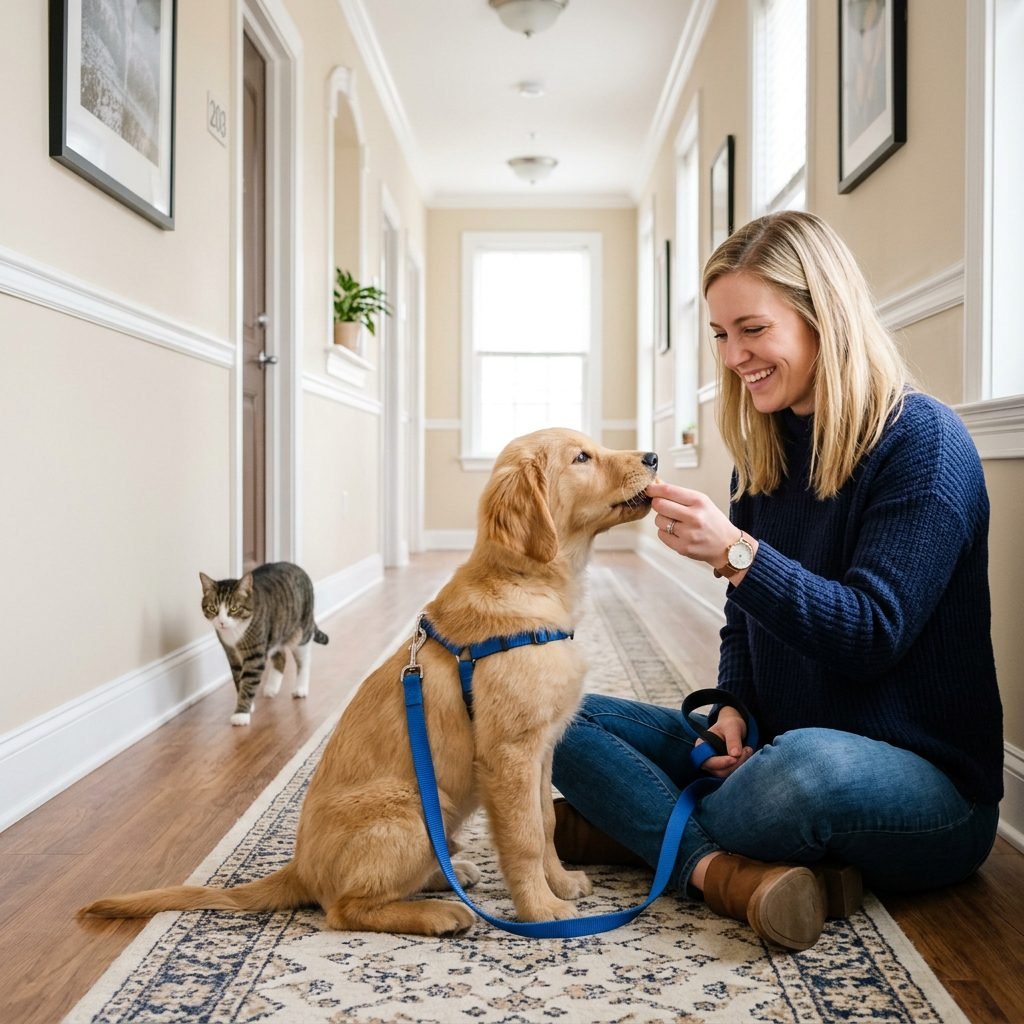
Now that your puppy understands impulse control in a vacuum, it is time to bring the cat into the picture. But we are not going to just throw them together and hope for the best. We are going to use a psychological technique called desensitization and counter-conditioning. The goal is to change the puppy’s emotional response to the cat from ‘OMG A TOY MUST CHASE!’ to ‘Oh, it is just the cat, and when the cat is around, I get chicken from my human.’
Understanding the ‘Threshold’
Every dog has a threshold. This is the invisible line between being aware of a trigger (the cat) and reacting to that trigger (lunging and chasing). If your puppy is barking, pulling on the leash, or unable to take a treat, they are over threshold. Learning cannot happen here. You must find the distance at which your puppy notices the cat but can still respond to your commands. This might be 10 feet away, or it might be across a large room.
The Desensitization Setup
Here is how you execute a controlled training session:
- Secure the Puppy: Put your puppy on a leash and sit with them in a room. Have a pouch full of the highest value treats you can find (hot dogs, cheese, boiled chicken).
- Introduce the Cat: Have a family member bring the cat into the room, or wait for the cat to naturally wander in. Ensure the cat has an easy escape route and is not feeling trapped.
- Play the ‘Engage/Disengage’ Game: The moment your puppy looks at the cat, say ‘Yes!’ and pop a treat in their mouth. Do this before they have a chance to bark or lunge. You are rewarding them simply for looking at the cat without reacting.
- Ask for More: After a few repetitions, wait a second before saying ‘Yes!’. See if your puppy looks at the cat, and then naturally turns their head back to you, expecting the treat. When they make that choice on their own, throw a massive praise party and give a jackpot of treats!
- Decrease the Distance: Over several days or weeks, gradually decrease the distance between the puppy and the cat. If the puppy ever lunges, you have moved too fast. Back up to a successful distance and try again.
What If They Lunge?
If the puppy breaks and tries to chase, do not yell or yank the leash. Simply use the leash to gently guide them away, say ‘Oops, let us go,’ and remove them from the room. The consequence of chasing is that they lose access to you, the treats, and the fun environment. Try again later when they are calmer.
Rule 5: Provide Better Outlets for Their Energy
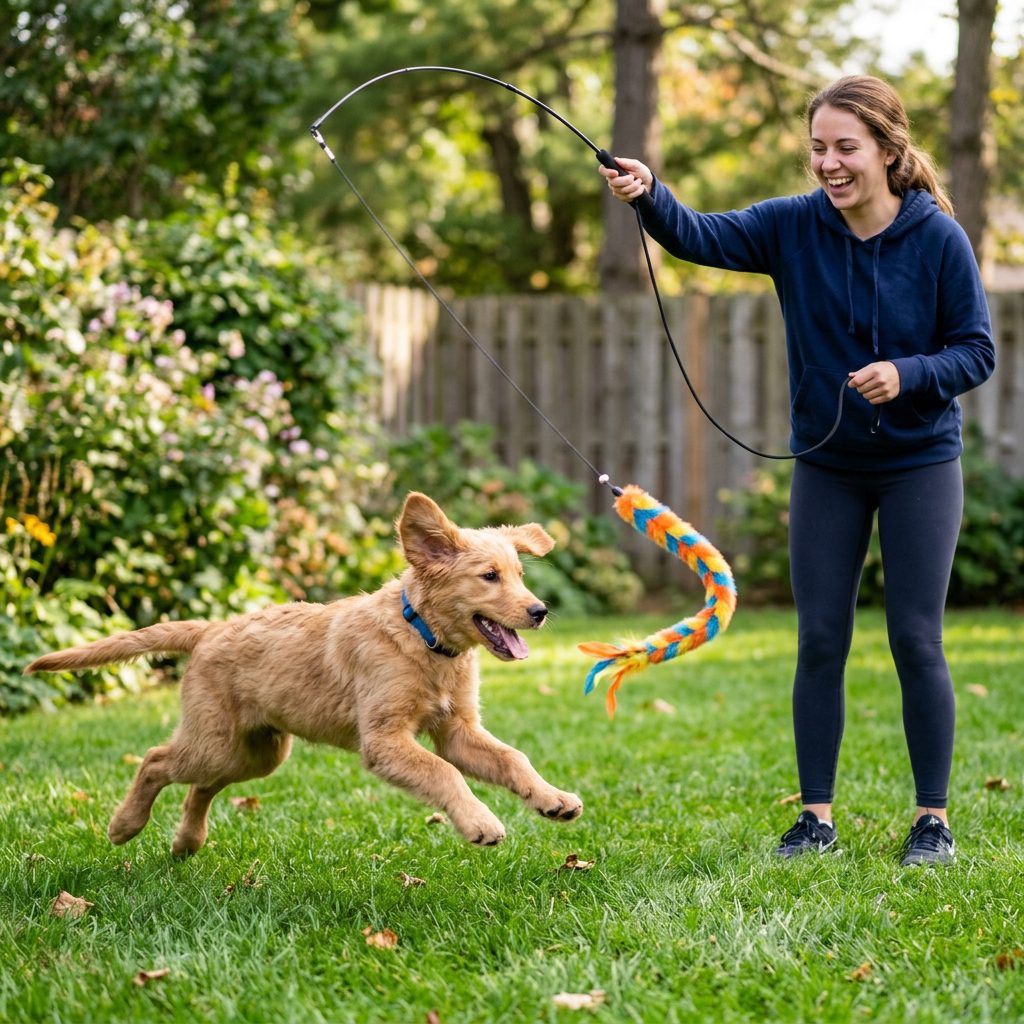
Puppies have an abundance of energy, and certain breeds have a genetic need to chase things. If you do not provide an appropriate, legal outlet for that energy, they will find their own outlets—and the family cat is usually the most convenient target. You cannot simply extinguish a natural drive; you must redirect it into something positive.
Physical Enrichment: The Flirt Pole
If your puppy loves to chase, give them something they are absolutely allowed to chase! A flirt pole is one of the best tools for savvy dog owners. It looks like a giant cat wand toy, consisting of a pole, a bungee cord, and a fuzzy lure at the end.
Playing with a flirt pole allows your dog to sprint, stalk, pounce, and bite in a controlled manner. It tires them out physically and satisfies their predatory sequence safely. More importantly, you can use the flirt pole to practice impulse control. Ask your dog to ‘Sit’ and ‘Wait’ before you release them to chase the lure. Ask them to ‘Drop it’ when they catch it. This translates directly to better control around the cat.
Mental Enrichment: Brain Games
Physical exercise is great, but mental fatigue is even better for calming a hyperactive puppy. A bored puppy will harass the cat for entertainment. Keep their brains busy with:
- Puzzle Toys: Feed their daily meals out of snuffle mats, Kongs, or interactive puzzle boards instead of a standard bowl.
- Scent Work: Hide treats around the living room and teach your puppy to ‘Find it.’ Sniffing lowers a dog’s heart rate and naturally calms them down.
- Obedience Training: Short, 5-minute training sessions focusing on new tricks drain mental energy quickly.
Structured Nap Times
Finally, remember that an overtired puppy is a cranky, hyperactive puppy with zero impulse control. Puppies need 18-20 hours of sleep a day. If your puppy is relentlessly chasing the cat and will not settle down, they might actually be exhausted. Enforce regular nap times in a quiet crate, away from the cat, to allow their nervous system to reset.
Conclusion
Stopping your puppy from chasing the family cat is not an overnight fix. It requires a dedicated commitment to understanding their behavior, managing their environment, and consistently rewarding the choices you want to see. By implementing these 5 rules—understanding the drive, mastering management, teaching impulse control, practicing desensitization, and providing appropriate outlets—you are setting both of your pets up for a lifetime of success.
Remember to be patient with your puppy, and equally patient with yourself. There will be setbacks and frustrating days, but as a savvy dog owner, you have the tools and the knowledge to guide them through it. Celebrate the small victories, like a calm glance or a successful ‘Leave it,’ and before you know it, your home will transform back into the peaceful, multi-pet sanctuary you always dreamed of.