

No More Fear! How To Desensitize Your Puppy To Thunder, Fireworks, And Loud Noises
Hey there, savvy puppy parents! We all know the feeling: the sky turns a dark, ominous shade of purple, the wind picks up, and suddenly, a massive clap of thunder rattles the windows. Or maybe it is the Fourth of July, and your neighborhood has suddenly transformed into a booming fireworks display. For us, these are just normal parts of life. But for our sweet, sensitive puppies, these sudden, booming sounds can be absolutely terrifying.
If you have ever watched your confident little furball turn into a trembling, panting mess hiding under the sofa, you know how heartbreaking noise anxiety can be. But here is the fantastic news: it does not have to be this way! You have the power to change how your puppy feels about these scary sounds.
Welcome to the wonderful world of desensitization and counter-conditioning. These might sound like fancy, intimidating psychological terms, but they are actually incredibly straightforward, highly effective training techniques. As a canine specialist, I am here to walk you through exactly how to use these methods to help your puppy conquer their fears. By taking a proactive approach now, you are setting your dog up for a lifetime of calm, confident behavior, no matter what is booming outside. Let us dive into the ultimate step-by-step guide to noise desensitization!
Understanding Your Puppy’s Fear of Loud Noises

Why Are Puppies So Scared of Noises?
Before we can fix the problem, we need to understand the why behind it. Puppies experience the world very differently than we do, especially when it comes to their senses. A dog’s hearing is incredibly acute; they can hear frequencies ranging from 40 to 60,000 Hertz, while human hearing ranges from 20 to 20,000 Hertz. This means that a thunderstorm does not just sound louder to them—they are actually hearing high-frequency crackles and rumbles that we cannot even perceive.
The Role of Fear Periods
It is also crucial to understand your puppy’s developmental stages. Puppies go through specific fear impact periods. The first typically occurs around 8 to 11 weeks of age, and a second, often more pronounced fear period happens during adolescence (around 6 to 14 months). During these windows, a single scary event—like a sudden firework exploding while they are out for a potty break—can imprint a lasting phobia if not handled correctly.
Expert Tip: Never force your puppy to ‘face their fears’ by dragging them closer to a scary noise. Flooding a dog with their trigger only deepens the trauma and breaks the trust they have in you.
Instead of forcing exposure, our goal is to gradually introduce the noise at a level the puppy can handle, which brings us to our core strategy: desensitization and counter-conditioning.
Your Desensitization Toolkit
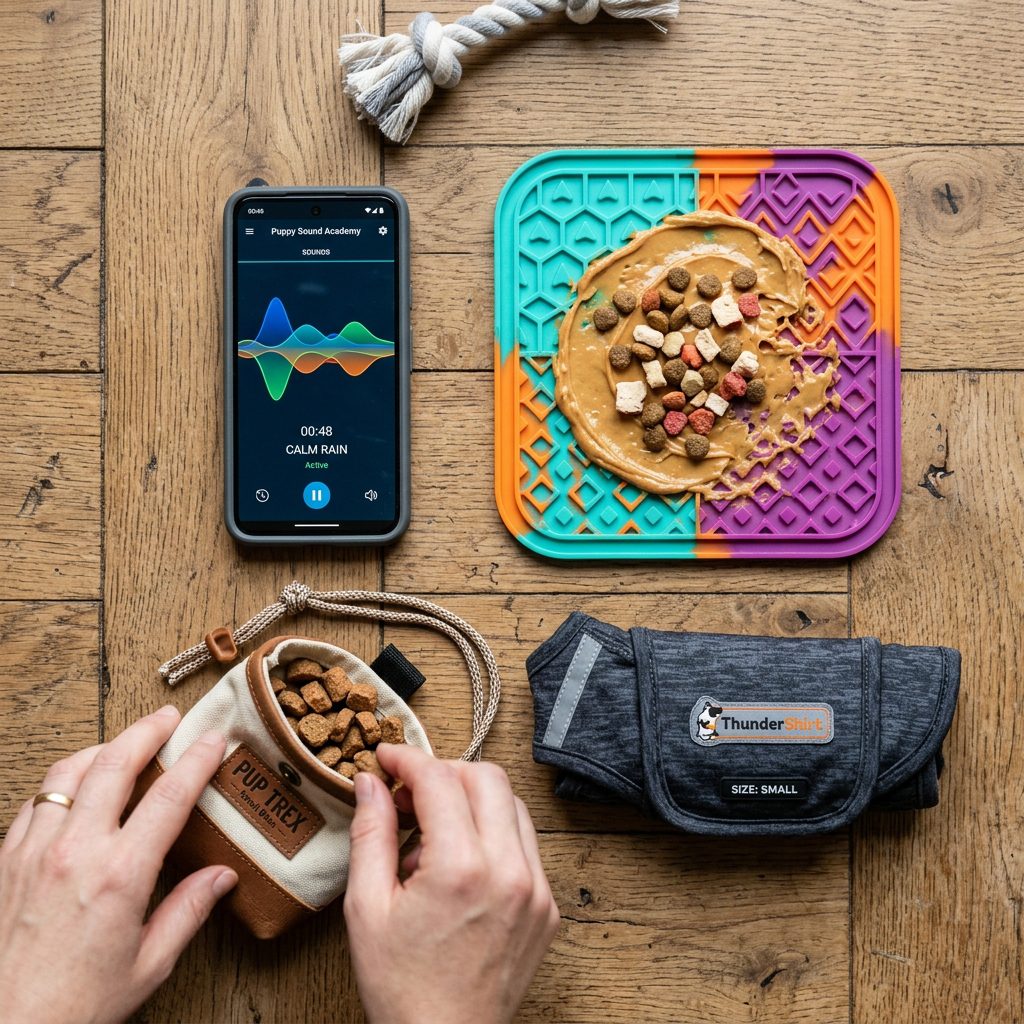
Gearing Up for Success
To successfully desensitize your puppy to thunder, fireworks, and other loud noises, you need to gather a few essential tools. Think of this as your canine confidence-building toolkit. You want to have everything prepared before you start a training session so you can focus entirely on your puppy’s body language and timing.
The Essentials
- A High-Quality Sound Source: You will need a smartphone, tablet, or Bluetooth speaker. There are numerous free apps and YouTube playlists specifically designed for dog desensitization that feature high-quality recordings of thunderstorms, fireworks, vacuum cleaners, and city traffic.
- High-Value Rewards: This is not the time for your dog’s standard dry kibble. You need the good stuff! Think boiled chicken breast, small bits of hot dog, freeze-dried liver, or a lick mat smeared with dog-safe peanut butter.
- A Safe Space: Choose a quiet, comfortable room where your puppy already feels relaxed.
Here is a quick breakdown of how these tools work together to change your dog’s emotional state:
| Tool Category | Examples | Purpose in Training |
|---|---|---|
| Audio Triggers | Sound Proof Puppy App, YouTube playlists | Provides controlled, adjustable exposure to the scary noises. |
| High-Value Rewards | Boiled chicken, cheese, lick mats | Creates a strong positive emotional response (Counter-Conditioning). |
| Comfort Gear | Thundershirt, Calming Pheromone Diffusers | Helps lower the puppy’s baseline anxiety levels during the process. |
The Step-by-Step Desensitization Process

The Steps to a Calm Canine
Now we get to the fun part: the actual training. The combination of desensitization (gradual exposure) and counter-conditioning (changing the emotional response from negative to positive) is the gold standard in behavior modification.
Step 1: Establish a Baseline of Calm
Start in your designated safe space. Do not play any sounds yet. Just sit with your puppy, ask for a simple command like sit or down, and give them a treat. You need to know what your puppy looks like when they are completely relaxed. Are their ears soft? Is their breathing steady? Is their tail gently wagging? This is your baseline.
Step 2: Introduce the Sound at a Whisper
Take your phone or speaker and play the thunderstorm or fireworks track at the absolute lowest possible volume. It should be so quiet that you can barely hear it. Watch your puppy closely. If they notice the sound (maybe an ear flickers) but they do not show signs of stress, immediately praise them and offer a high-value treat.
Step 3: Pair the Noise with the Reward (Counter-Conditioning)
The sequence here is critical: Noise first, then Treat. The noise must become the predictor of the amazing chicken or hot dog. Play the quiet sound, wait one second, and deliver the treat. Repeat this process for about 2 to 3 minutes. Your puppy should start to look at you with bright eyes, expecting a treat as soon as they hear the rumble. They are learning that thunder equals chicken!
Step 4: Gradually Increase the Volume
Over the next few days or weeks, slowly increase the volume of the track. If your puppy ever shows signs of stress—such as yawning, lip licking, pinning their ears back, or refusing the treat—you have gone too far, too fast. Turn the volume back down to the last successful level and end the session on a positive note.
Expert Tip: Keep your training sessions incredibly short. 3 to 5 minutes, once or twice a day, is far more effective than a grueling 30-minute session that leaves both you and your puppy exhausted.
Managing Real-Life Events Before Training is Complete
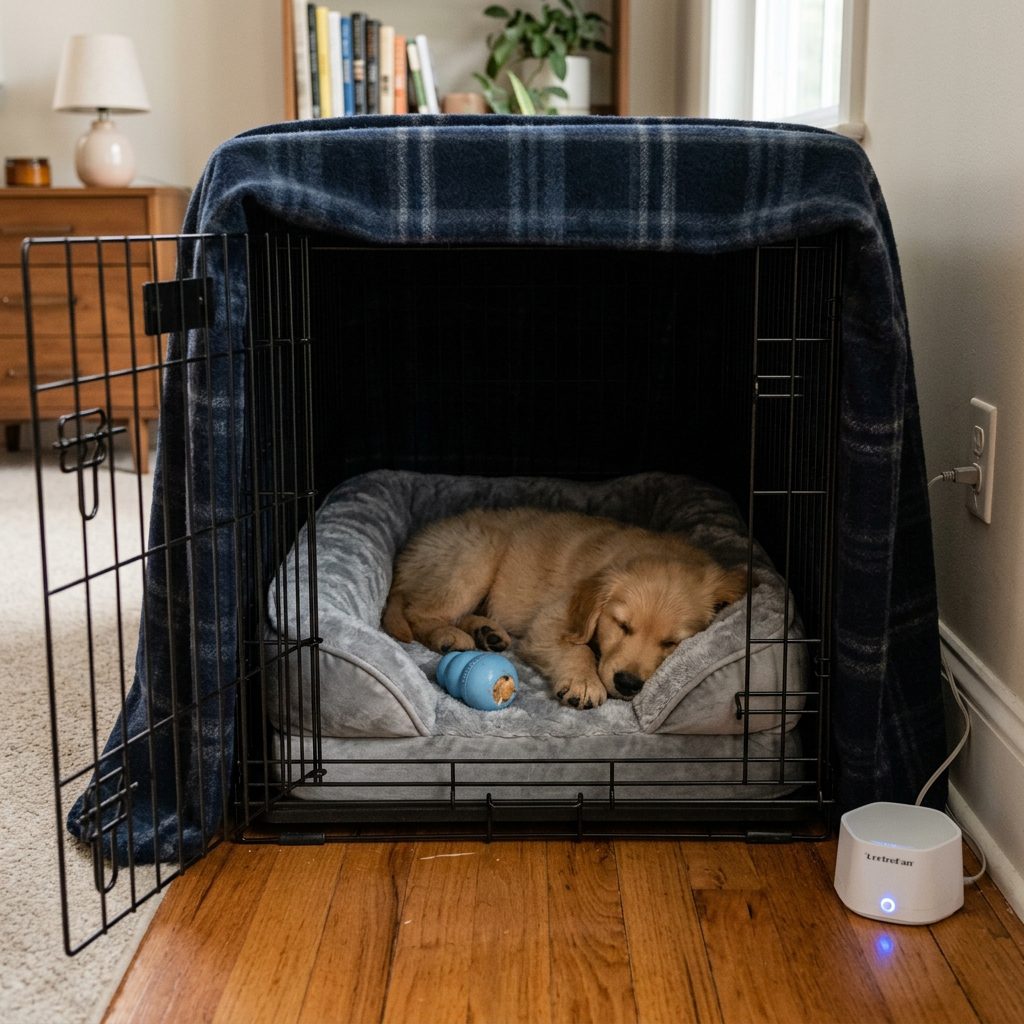
What to Do When a Real Storm Hits
Training takes time. You might be on week two of desensitization, successfully playing thunder sounds at a medium volume, when a massive, real-life thunderstorm rolls into your town. What do you do? This is where management comes into play. Management is about preventing your dog from practicing the fearful behavior and protecting the progress you have made.
Creating a Noise-Proof Bunker
When a real storm or fireworks display happens, your goal is to mask the sound and keep your puppy as comfortable as possible. You are no longer training; you are surviving the event.
- Close the Curtains: Flashes of lightning or fireworks can be just as triggering as the noise. Blackout curtains are excellent for this.
- Turn Up the White Noise: Turn on a box fan, play classical music, or use a white noise machine to drown out the booming sounds from outside.
- Provide Long-Lasting Chews: Give your puppy a stuffed, frozen Kong or a long-lasting chew. Chewing and licking release endorphins in a dog’s brain, which naturally helps soothe anxiety.
If your puppy wants to hide in their crate or under the bed, let them! Ensure their chosen safe space is accessible and comfortable. You can sit near them and offer calm, soothing praise.
Common Mistakes and Troubleshooting

Avoiding the Pitfalls of Noise Training
Even the most savvy dog owners can run into roadblocks when desensitizing their puppies. Here are the most common mistakes to watch out for, and how to troubleshoot them.
Mistake 1: Rushing the Process
This is the number one reason desensitization fails. We get impatient and turn the volume up too quickly. Remember, your puppy dictates the pace. If it takes three weeks just to get the volume to a conversational level, that is perfectly fine. Patience is your greatest asset.
Mistake 2: The ‘Comforting Reinforces Fear’ Myth
For decades, old-school trainers told owners never to comfort a scared dog because it would ‘reinforce the fear.’ Modern veterinary behaviorists have completely debunked this. You cannot reinforce an emotion. If you are terrified of spiders, and someone hands you a hundred-dollar bill while you are screaming, you do not become more afraid of spiders—you are just a scared person with a hundred dollars. If your puppy is terrified, calmly petting them and speaking in a soothing voice will not make them more fearful. It shows them you are a safe, supportive leader.
Mistake 3: Using Low-Value Treats
If you are trying to overcome a deep-seated phobia with dry, boring kibble, you are going to struggle. The reward must be spectacular enough to outweigh the fear of the noise. If your puppy stops taking treats, the noise is either too loud, or the treats are not good enough. Upgrade to real meat or cheese, and lower the volume.
Conclusion
Desensitizing your puppy to thunder, fireworks, and loud noises is one of the greatest gifts you can give them. By understanding their fears, equipping yourself with the right tools, and patiently working through the steps of counter-conditioning, you are actively rewiring their brain to feel safe in a noisy world.
Remember, there is no set timeline for this journey. Every puppy is an individual with their own unique quirks and sensitivities. Celebrate the small victories—like your puppy taking a treat during a low rumble of thunder—and give yourself grace on the tough days. Stay consistent, keep those high-value treats handy, and always advocate for your dog’s comfort. You have got this, and your puppy is so lucky to have a savvy, dedicated owner like you in their corner. Happy training!