Stop the Wrestling Match: How to Stop a Puppy Biting When Putting on a Harness
The Daily Harness Struggle
If you are reading this, you probably know the drill all too well. You cheerfully grab your puppy’s harness, ready for a fun, relaxing walk around the neighborhood. But the moment that fabric comes within an inch of your dog, your sweet little furball transforms into a tiny, teeth-gnashing alligator. Suddenly, you are locked in a wrestling match. You are trying to slip a loop over a moving target, dodging razor-sharp puppy teeth, and wondering why a simple walk has to start with a battle of wills. Rest assured, you are not alone, and you are certainly not a bad dog owner.
Puppy biting during harness application is one of the most common complaints among new and savvy dog owners alike. It is frustrating, it hurts, and it can set a stressful tone for the entire walk. But here is the good news: this behavior is entirely normal, and more importantly, it is entirely fixable. By understanding the psychology behind why your puppy sees the harness as a chew toy or a threat, and by implementing a strategic, positive-reinforcement-based training plan, you can turn harness time into a calm, cooperative bonding experience.
In this comprehensive guide, we are going to break down exactly why your puppy attacks their walking gear. We will cover the essential tools you need to change their emotional response, walk you through a foolproof step-by-step desensitization protocol, and help you troubleshoot the most common mistakes owners make along the way. Grab a handful of high-value treats, take a deep breath, and let us get started on stopping the wrestling match for good.
Understanding Why Your Puppy Bites the Harness
The World Through a Puppy’s Mouth
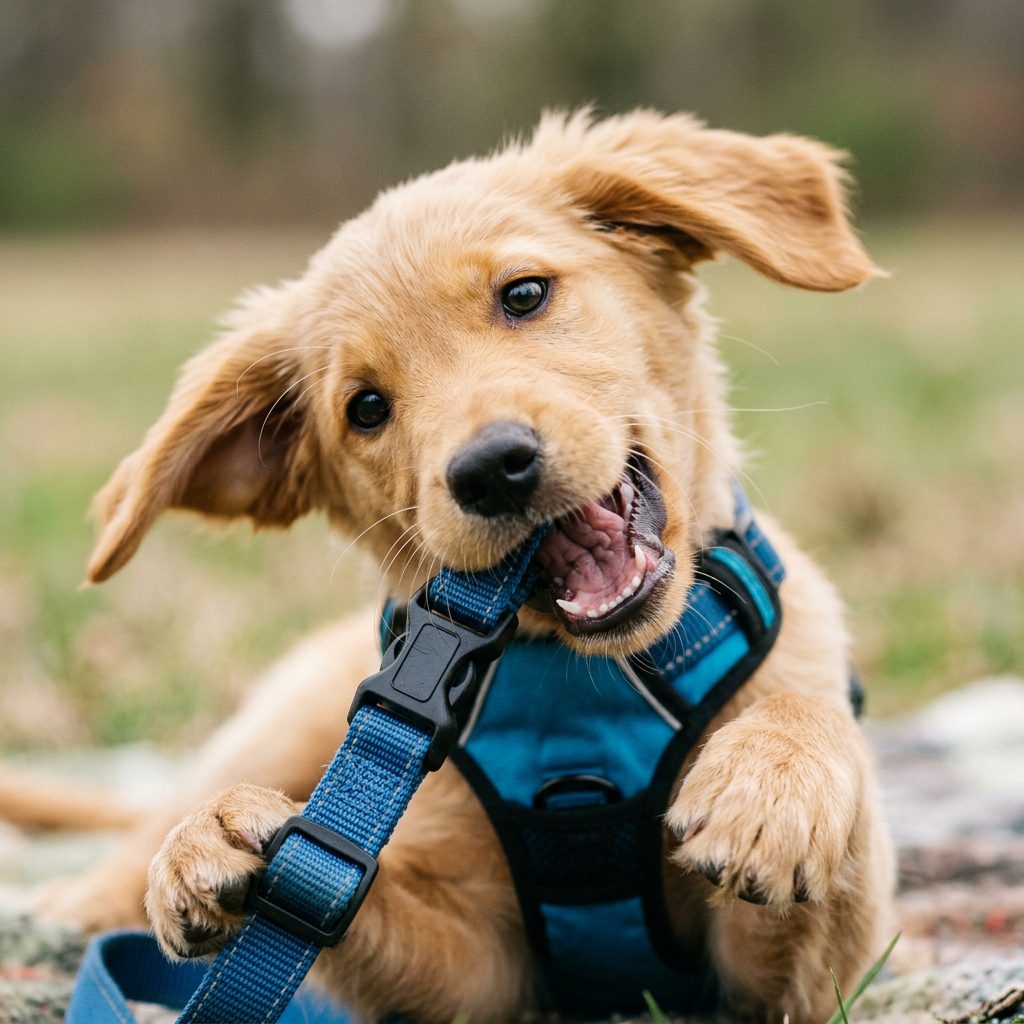
Before we can fix the biting, we have to understand the ‘why’ behind it. Puppies do not have hands; they explore their entire world using their mouths. When you dangle a harness in front of them, complete with swinging straps and jingling metal rings, their immediate instinct is to grab it. To a young dog, a harness looks incredibly similar to their favorite tug toy. If you pull the harness away when they bite it, you inadvertently trigger their prey drive, turning the interaction into a highly rewarding game of tug-of-war.
Restraint Sensitivity and the Opposition Reflex
Beyond simple playfulness, there is a deep-rooted psychological element at play known as restraint sensitivity. Dogs, by nature, are cursorial animals, meaning they are built to run and move freely. When we lean over a puppy—a posture that can feel intimidating in canine body language—and attempt to strap a restrictive device over their head or around their chest, their natural instinct is to resist. This is tied to the ‘opposition reflex,’ an instinctive reaction where a dog pushes back against pressure. Biting is their way of saying, ‘Hey, I do not like this, back off!’
Teething Discomfort
Between the ages of 12 and 24 weeks, puppies go through an intense teething phase. Their gums are sore, swollen, and constantly irritated. Chewing provides significant relief by massaging the gums and releasing endorphins. If your puppy is in the thick of teething, any object that comes near their face—including hands, leashes, and harnesses—is a prime candidate for a soothing chew session. Recognizing this allows us to approach the training with empathy rather than frustration.
Anticipation and Over-Arousal
Finally, consider the context. What happens right after the harness goes on? You go for a walk! Walks are incredibly stimulating, filled with new smells, sights, and sounds. As soon as you pick up the harness, your puppy’s arousal levels skyrocket. They become overwhelmed with excitement, and that excess energy often spills over into hyperactive behaviors, including jumping, vocalizing, and mouthing. They simply do not have the impulse control yet to contain their excitement.
Essential Tools to Set Your Puppy Up for Success
Equipping Yourself for Bite-Free Training
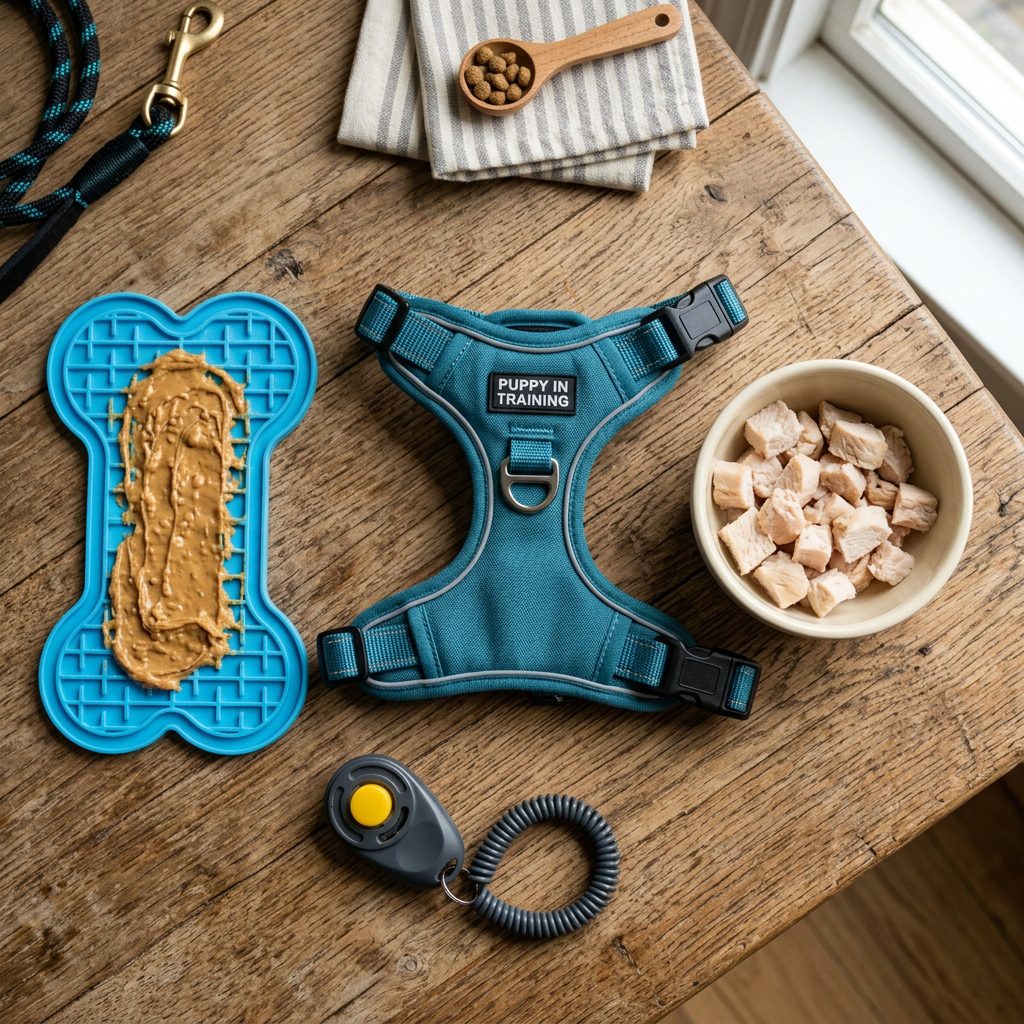
You cannot build a house without the right tools, and you cannot train a puppy without the proper equipment. Setting yourself up for success means moving away from the standard kibble and investing in tools that will capture your puppy’s attention and change their emotional state from chaotic to calm.
1. High-Value Reinforcement
When we say ‘high-value,’ we mean treats that your puppy absolutely loses their mind over. Dry kibble or hard biscuits will not cut it when you are competing with the excitement of a walk or the instinct to bite. You need soft, smelly, and easily consumable treats. Excellent options include boiled chicken breast, small pieces of hot dog, freeze-dried liver, or even a squeeze tube of xylitol-free peanut butter. The goal is to provide a reward so incredible that the puppy would rather focus on the food than the harness.
2. The Lick Mat or Smear Tool
A lick mat is a secret weapon for savvy dog owners. By smearing wet food, yogurt, or peanut butter on a textured silicone mat and freezing it, you create a long-lasting distraction. Licking is a naturally soothing behavior for dogs that lowers their heart rate and promotes calmness. Placing a lick mat on the floor or sticking it to a wall can keep your puppy’s mouth occupied while you manage the harness buckles.
3. Choosing the Right Harness Design
Not all harnesses are created equal, especially for puppies. The style of harness you choose can dramatically impact how your puppy reacts to having it put on. Let us break down the most common types and how they affect the training process.
| Harness Type | Pros for Puppies | Cons for Puppies |
|---|---|---|
| Over-the-Head (Y-Harness) | Provides a secure fit, allows for natural shoulder movement, and is very difficult for a wiggly puppy to slip out of. | Requires pushing the harness over the puppy’s sensitive head and ears, which is the number one trigger for biting, backing away, and head-shyness. |
| Step-In Harness | Completely avoids the head and neck area during application, eliminating the fear of objects coming over the face. | Requires manipulating the puppy’s paws and legs. Many puppies have sensitive feet and will instinctively bite hands that try to grab their legs. |
| Neck-Buckle Harness | The gold standard for training. It wraps around the neck and chest and buckles securely without ever going over the head or requiring paw handling. | Can be slightly more expensive and sometimes difficult to find in extra-small or micro-puppy sizes. |
The Step-by-Step Guide to a Bite-Free Harness Routine
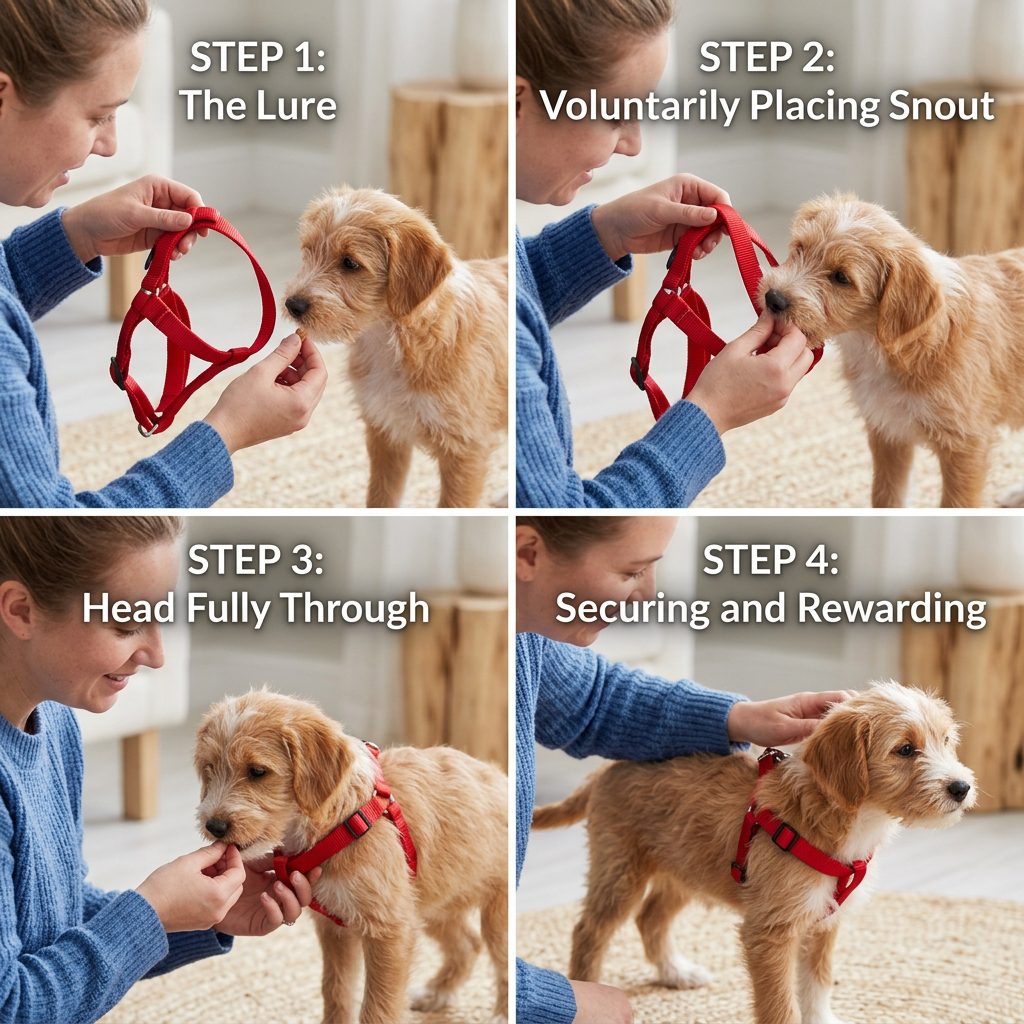
Phase 1: Desensitization and Changing the Association
The first step is to completely disconnect the harness from the walk. If the harness only appears when your puppy is highly aroused, they will always react with high energy. Bring the harness out during quiet times, like when you are watching TV. Place it on the floor. Every time your puppy looks at it or sniffs it without biting, say ‘Yes!’ and toss them a high-value treat. Do this for three minutes, then put the harness away. Repeat this several times a day until your puppy sees the harness and immediately looks to you for a treat, rather than trying to attack the straps.
Phase 2: The Voluntary Nose Target
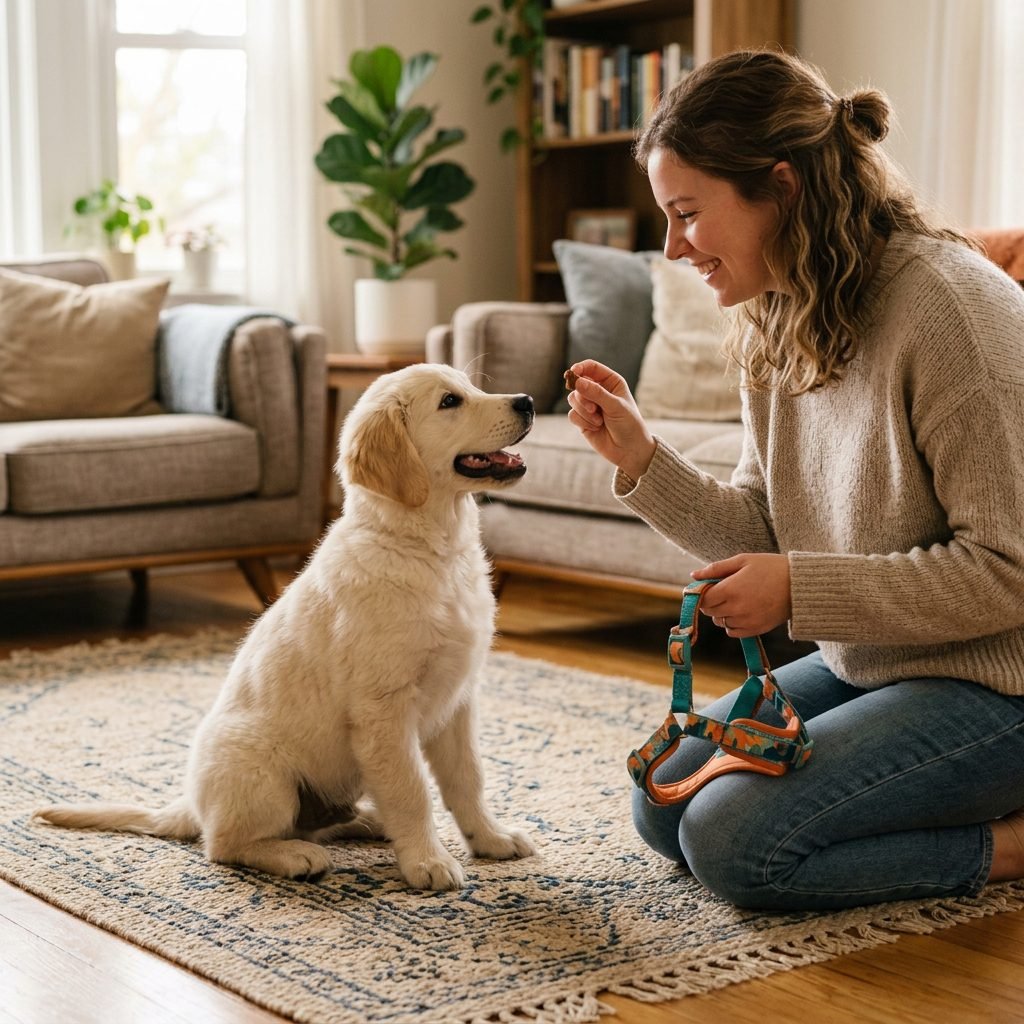
We never want to force the harness over the puppy’s head. Instead, we want the puppy to choose to put their head through. Hold the harness loop in one hand and a highly desirable treat in the other. Position the treat right in the middle of the head hole. Allow your puppy to eat the treat through the hole. Crucial tip: Do not move the harness toward the puppy. Let the puppy move their head toward the harness. Gradually pull the treat further back so the puppy has to poke their nose, then their snout, and finally their whole head through the loop to get the reward.
Phase 3: Building Duration and Tolerance
Once your puppy is comfortably putting their head through the loop, we need to build duration. Puppies often bite when the harness rests on their neck because it feels strange. Have your puppy put their head through the loop, and instead of just giving one treat, feed them a continuous stream of small treats for five to ten seconds while the harness rests on their shoulders. If they back out, let them! Never trap them. The goal is to teach them that keeping their head inside the harness results in a magical waterfall of snacks.
Phase 4: Conquering the Buckles
The sound and feel of buckles snapping shut right behind a puppy’s front legs can be startling, leading to sudden twisting and biting. To fix this, first desensitize them to the sound. Click the buckle repeatedly in the air near the puppy, treating them after every click. Once they ignore the sound, it is time to fasten it on their body. This is where your lick mat or a helper comes in handy. Have the puppy focus entirely on licking a continuous reward while you calmly and swiftly reach under their belly and fasten the clips. If you are training solo, you can scatter a handful of treats on the ground to keep their nose down and mouth busy while you buckle up.
Troubleshooting Common Harness Training Mistakes
Mistake 1: Chasing the Puppy
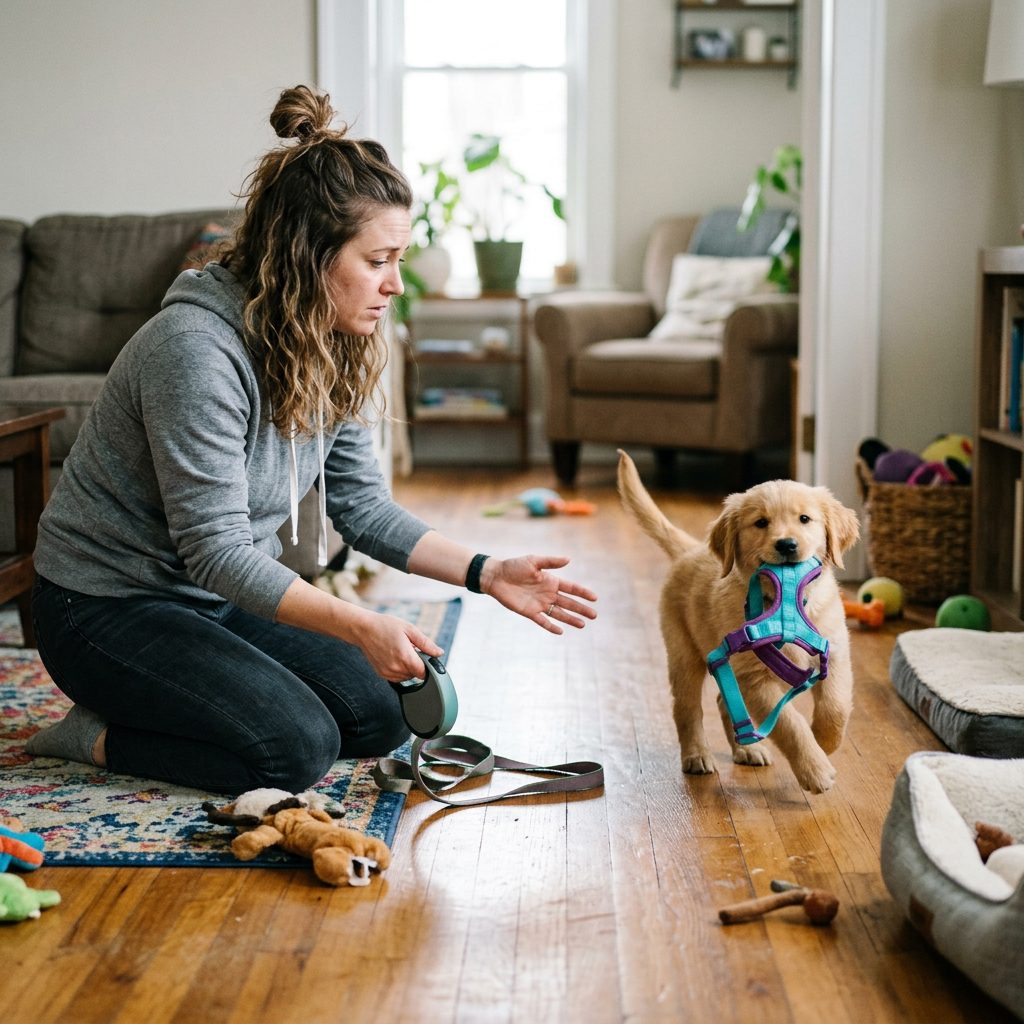
One of the most detrimental things you can do is chase your puppy around the living room with the harness. To a puppy, being chased is the ultimate game of tag. It reinforces the idea that harness time is playtime. If your puppy runs away, stop. Sit down, ignore them, and wait for them to come back to you. Use your high-value treats to lure them into a calm sit before attempting the process again.
Mistake 2: Scolding or Physical Corrections
It is incredibly easy to lose your patience when sharp puppy teeth are digging into your hands. However, yelling ‘No!’, tapping their nose, or forcibly holding them down will only make the problem worse. These actions create a negative emotional association with the harness. Your puppy will begin to view the harness as a predictor of conflict and punishment, leading to defensive biting or fear-based avoidance.
“Training your puppy to love their harness is not just about making daily walks easier; it is about building foundational trust between you and your dog during handling. Patience now prevents behavioral issues later.” – Canine Behavior Expert
Mistake 3: Moving Too Fast
Many owners try to accomplish all the steps in a single session. Dog training is a marathon, not a sprint. If your puppy starts biting during Phase 3, it means you moved on from Phase 2 too quickly. Always go back to the previous successful step and build a stronger foundation. Keep your training sessions incredibly short—no more than three to five minutes at a time. Always end on a positive note, even if that just means the puppy sniffed the harness without biting.
What If They Bite the Leash Too?
Often, harness biting evolves into leash biting. If your puppy redirects their frustration onto the leash, keep the leash completely slack. A tight leash triggers the opposition reflex and encourages tugging. You can also utilize two leashes: let them hold one in their mouth like a pacifier while you use the other for actual guidance, or use a bitter apple spray on the lower section of the leash to make it unappealing.
Conclusion
Consistency is the Key to Calmness
Transforming your puppy from a harness-hating alligator into a calm, cooperative walking companion does not happen overnight. It requires patience, high-value rewards, and a commitment to moving at your puppy’s pace. Remember that puppyhood is a temporary phase filled with rapid learning and development. Every single time you pick up that harness, you are conducting a training session. By utilizing desensitization techniques, avoiding forceful restraint, and keeping your own energy calm and positive, you will effectively stop the wrestling match.
Stay consistent, celebrate the small victories—like a perfectly executed nose target or a buckle click without a bite—and soon enough, picking up the harness will result in a happy, seated puppy ready to explore the world with their favorite person.