Silence The Barking: Training Dogs To Be Quiet During Zoom Meetings
The shift to remote work has brought about many conveniences, but for dog owners, it has introduced a unique challenge: the dreaded background bark during a critical presentation. As a canine specialist, I frequently hear from clients who are struggling to balance their professional obligations with the needs of their vocal companions. The anxiety of hovering over the mute button while your dog reacts to a delivery driver or demands attention can be overwhelming.
Barking is a natural form of communication for dogs, but when it interrupts your workflow, it becomes a behavioral issue that requires management and training. It is important to understand that your dog is not trying to sabotage your career; they are often reacting to boredom, anxiety, or environmental triggers. By implementing a structured approach involving preparation, specific training commands, and environmental management, you can teach your dog that your office hours are a time for relaxation.
In this guide, we will move beyond simple distractions and explore the behavioral psychology behind why dogs bark during calls. We will provide you with a step-by-step protocol to desensitize your dog to your work routine and establish a peaceful coexistence in your home office.
Phase 1: Pre-Meeting Preparation and Needs Assessment

Success in dog training often happens before the training session actually begins. If a dog’s biological and psychological needs are not met, asking them to remain silent for an hour is setting them up for failure. A bored or energetic dog is a vocal dog. Before you log into your first meeting of the day, you must ensure your canine companion is ready to settle down.
Physical Decompression
Physical exercise is the most effective anxiety reducer. A tired dog is generally a quiet dog. However, a simple walk around the block may not be sufficient for high-energy breeds. Engage in activities that raise the heart rate, such as a game of fetch or a brisk jog, at least 30 minutes before your work block begins.
Mental Enrichment
Mental fatigue is often more exhausting than physical exercise. Utilizing enrichment tools can keep a dog’s brain occupied and their mouth busy—literally preventing barking. Consider the following tools:
- Lick Mats: Freezing peanut butter or yogurt on a textured mat can soothe a dog and keep them occupied for extended periods.
- Puzzle Toys: Devices that require the dog to manipulate parts to release food engage their problem-solving skills.
- Frozen Kongs: A classic tool that, when stuffed and frozen, acts as a long-lasting pacifier.
By timing these activities to coincide with the start of your meeting, you create a positive association with your work routine.
Phase 2: The ‘Place’ Command Protocol

The most valuable command for a work-from-home scenario is the "Place" command. Unlike a simple "Down-Stay," the Place command teaches the dog to go to a specific location (like a bed or mat) and remain there until released. This provides a clear job for the dog: their job is to relax on their spot.
Step-by-Step Training
To teach this behavior effectively, follow this progression:
- Lure and Reward: Use a high-value treat to lure your dog onto their bed. As soon as all four paws are on the mat, mark the behavior with a word like "Yes" and reward them.
- Add the Cue: Once the dog is following the lure reliably, add the verbal cue "Place" just before they step onto the mat.
- Build Duration: Gradually increase the time the dog stays on the mat before releasing them. Start with seconds and work up to minutes. Do not expect a 60-minute duration immediately.
- Add Distractions: Practice this command while you are sitting at your desk, typing, or talking to yourself to simulate a meeting environment.
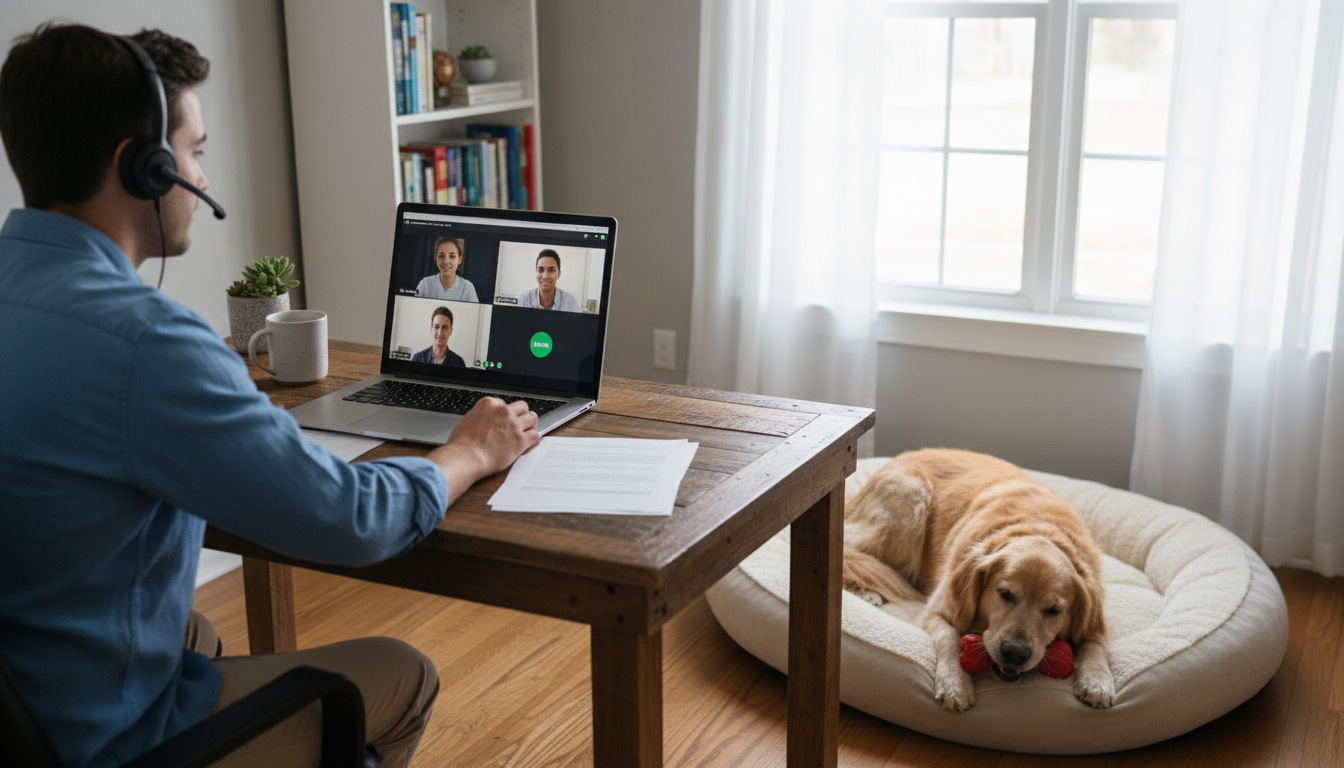
During a Zoom meeting, having your dog in a reliable "Place" near you allows you to reinforce their calm behavior intermittently without disrupting your workflow.
Phase 3: Desensitizing to ‘The Voice’

Many dogs bark specifically when their owners start talking to a screen. To a dog, this is confusing behavior. You are speaking, but not to them, and often using a different tone of voice (your "meeting voice"). This can trigger demand barking or excitement.
Counter-Conditioning the Headset
We need to change the dog’s emotional response to your meeting cues. You can practice this outside of actual work hours:
- The Setup: Put on your headset or sit at your desk. If your dog remains quiet, toss a treat.
- The Mock Call: Start talking to your computer as if you are in a meeting. If your dog barks, ignore them completely (negative punishment). Wait for a moment of silence—even just a second—and immediately mark and reward.
- The Bridge: You are teaching the dog that your "meeting voice" is a cue for them to settle down and wait for rewards, not a cue to join the conversation.
Consistency is key here. If you acknowledge the barking by saying "No" or "Quiet" while looking at them, you have just reinforced the behavior by giving them attention.
Phase 4: Emergency Management and Troubleshooting

Even with the best training, environmental triggers can occur. The delivery driver rings the doorbell, or a squirrel appears at the window. When you are in a high-stakes meeting, you need immediate management strategies rather than training lessons.
Environmental Management
Control the environment to reduce the likelihood of triggers:
- Visual Barriers: Close blinds or apply opaque window film to prevent your dog from seeing triggers outside.
- Auditory Masking: Use a white noise machine or play calming classical music to drown out external sounds that might provoke an alert bark.
- The ‘Quiet Room’: If your dog is prone to separation anxiety or excessive barking, it may be best to set up a safe, comfortable room away from your office where they can relax with their enrichment toys during critical calls.
What to Do When Barking Happens
If your dog starts barking mid-meeting, do not yell. Yelling adds chaotic energy to the situation and often makes dogs bark more (they think you are barking along with them). Calmly toss a handful of treats away from you (a "treat scatter") to redirect their focus to the floor, engaging their nose and quieting their mouth.
Consistency Creates Calm
Training a dog to be quiet during Zoom meetings is not an overnight fix; it is a process of conditioning and management. By ensuring your dog’s physical and mental needs are met before you clock in, teaching a solid "Place" command, and managing the environment to reduce triggers, you can create a workspace that works for both of you.
Remember to be patient with your dog. They are social creatures adjusting to a human-centric routine. With consistent reinforcement of calm behavior and the right preparation, the only thing your colleagues will notice is your professionalism, not your background noise.